Thursday, July 8, 2021

Kirby's wonderful world rickles with madness


At the time of the greatest climax in the counter-culture’s war against the State, Jack Kirby gave us….double Rickles. To be more precise, Goody and Don because one Rickles deserves another. And no Superman because, well, Superman isn’t funny. Kirby’s second, comedic, rollicking Rickles tale in Jimmy Olsen # 141 (September, 1971), published 50 years ago today, 8 July, 1971, is another opportunity to put the ‘Merchant of Venom’, insult comedian Don Rickles, into the Fourth World. He features prominently on the cover and to the bemused reader, Kirby’s invitation is simply, ‘Don’t ask! Just buy it!’

Taken together, the two Don Rickles issues (see my commentary on Jimmy Olsen # 139, # 140 is an all-reprint giant size comic) are like an extended Dad joke. Only this time you get to go to the office with Dad, like those times at school when you’d write a book report the next day which said something like ‘my Dad sits at a desk and types and it seems very boring’ (hint: the school system does this to prepare you for your adult life, remember?). When Don Rickles visits the office though, beautiful girls love being insulted by him (I’ve never found this a workable seduction technique), middle-aged men act like man-love groupies and want his autograph ‘write something weird and nasty!’ (again, preparation for the resident office sociopath, every office has one).

The focus of Kirby’s Fourth World is on the youth reader but in the two Don Rickles issues he shows the child reader the Parent World. It’s as if Kirby has sealed off the comic from the outside world, while the other three titles prominently feature hippie avatars and their concerns and savagely satirise public figures.

Outside Jimmy’s pages, in the weeks leading up to publication, Woodstock nation rushed towards its greatest climax, it had proved the Government had been spying on them¹ and a 40-year-old strategic analyst and friend to the Movement, Daniel Ellsberg (you can trust someone over 30), had leaked top secret government papers showing the Government had been lying to Americans about Vietnam.²

From Time Magazine, 5 July, 1971, pg. 13

The two revelations came at exactly the right time for the Movement, brought low by Kent State a year earlier and seemingly out of gas after the last big, anti-Vietnam War demonstrations in May, 1971.  The impact of the Pentagon Papers, showing untruths across multiple Republican and Democrat administrations, went right to the top. Nixon’s chief of staff H.R. Haldeman repeated a colleague’s point:

‘To the ordinary guy, all this is a bunch of gobbledygook. But out of the gobbledygook comes a very clear thing.... You can't trust the government; you can't believe what they say; and you can't rely on their judgment; and the – the implicit infallibility of presidents, which has been an accepted thing in America, is badly hurt by this, because It shows that people do things the president wants to do even though it's wrong, and the president can be wrong.’³

From Time Magazine, 5 July, 1971, pg. 13

The juxtaposition of the other three Fourth World titles and the two Rickles issues of Jimmy and the difference between what is happening within the pages versus what is happening outside them, is jarring. It’s a kind of madness reflected in the growing mental instability of Don Rickles, like a symbol of the establishment parent, who starts off with his insult jokes, becomes increasingly irritated and by the end of the story is literally carried off stage by men in white coats, unable to reconcile what he is hearing with what he is seeing.

Morgan Edge tries to calm people down after the explosive threat of Jimmy and the New Guardian’s ingestion of the chemical pryo-granulate has been neutralised, ‘We did have an emergency here! But it was brought under control!’ Don Rickles responds: ‘That’s a lie! I’m the bomb! And I’m primed to blow! Get me outta here! Stop me from killing!’ It’s like two sides of the State, one moving to acknowledge something has gone wrong and wanting to reassure the populace that the system is OK, the other warning that everything is going to fall apart.

Superman, the State saviour, is shuffled off stage in this issue. He meets Lightray for the first time but as Clark Kent (you never see him in costume within the issue), returning at the end via Boomtube, his loud entrance serving as the final insult to send Don Rickles over the Edge.  

Reading this issue, you might feel the same, it might drive you bananas, you might feel like you are on the ropes but hey, this is Kirby! It’s a wonderful world. Just listen to ol’ Pops.

‘Some of you young folks been saying to me," Hey Pops, what you mean 'What a wonderful world'? How about all them wars all over the place? You call them wonderful? And how about hunger and pollution? That ain't so wonderful either."

Well how about listening to old Pops for a minute. Seems to me, it ain’t the world that's so bad but what we're doin' to it. And all I'm saying is, see, what a wonderful world it would be if only we'd give it a chance. Love baby, love. That's the secret, yeah. If lots more of us loved each other, we'd solve lots more problems. And then this world would be a gasser.

That's wha' ol' Pops keeps saying."

I see trees of green, red roses too
I see them bloom, for me and you
And I think to myself
What a wonderful world….’

From the lyrics to It’s A Wonderful World (spoken version) by Louis Armstrong, 1970. Armstrong would pass away two days before Jimmy Olsen # 141 hit the stands, on 6 July, 1971.

¹On March 8, 1971, on the same night as Muhammad Ali fought Joe Frazier in New York in the ‘Fight of the Century’ with millions of people listening to radios or watching in theatres, the Citizen’s Commission to Investigate the FBI broke into an FBI office outside Philadelphia and stole 800 documents which showed the Government was spying on black and student groups. Time Magazine, 5 April, 1971, pg.15.

²The New York Times first published excerpts from the Pentagon Papers on 13 June, 1971, followed by the Washington Post, five days later. The US Government sought an injunction to stop publication of the material but in a 6-3 Supreme Court decision on 30 June, 1971, the court found the Government had not met the heavy burden on proof for the injunction.

³From Eddie Meadows’ June 14, 1971 transcript "Oval office meeting with Bob Haldelman, Nixon Presidential Materials Project, Oval-519-, Cassette 747"audio tape.

Research this article:                                           

Comics:

-Comics Journal # 134, February 1990 (Jack Kirby interview by Gary Groth)

-Mike’s Amazing World of Comics website

-The Indispensable Kirby & Lee: Stuf’ Said! (Jack Kirby Collector # 75: TwoMorrows).

Popular culture:

-Helter Skelter, the True Story of the Manson Murders (Vincent Bugliosi with Curt Gentry, W.W. Norton, 1994)

-There’s A Riot Going On (Peter Doggett, Canongate, 2007)

-Time Magazine, 5 July, 1971

-Uncovering the Sixties (Abe Peck, Pantheon, 1985) .

Michael Mead is a now, 55-year-old New Zealand comic book collector, who likes to think he can do "contextual" commentary reviews of old comics, asking: "where does this story come from?", looking at the social, political, cultural times it came from, the state of the comics industry, the personal and creative journey of the writer or artist, the personal journey of the reader as a child and as an adult. 

As part of this, he is vain enough to think he can bring new insights into Kirby's Fourth World comics and so, on the 50th anniversary of publication of each issue of Superman's Pal Jimmy Olsen, Forever People, New Gods and Mister Miracle, he will publish a contextual commentary. This is his 19th Fourth World commentary. Check out his earlier entries on this blog and tell him to stop talking so pretentiously in the third person for God's sake! 


Tuesday, June 15, 2021

Kirby's travels: riding the tempest

Are we truly beyond time? Are we beyond death? Young Esak poses these questions to Metron in Jack Kirby’s New Gods # 4 (September, 1971), published 50 years ago today, immortality being a perennial subject from Socrates to Swift to Superman, to Serifan.

Central to living forever is the idea that we can stop or even reverse the aging process, through scientific advancement. That we can stop time, preferably in our 25- year-old body, get beyond it as Esak says. While we’re waiting to be able to do that, some people, like baseball star Ted Williams, however involuntarily, have been put on ice. Secular resurrection it seems may also be an option in the future.

In comics both immortality and resurrection happen all the time. Death has lost its sting for superheroes who die valiant deaths only to eventually be revived, brought back, through some incredibly unlikely plot twist introduced just at the point a new generation of readers arrives. Immortal beings in comics are as common as multi-national tax avoiders.

As a Jewish man and regularly attender at Temple, Jack Kirby would have been familiar with the ancient Hebrew idea of Sheol, the underworld which claims the lives of humans, whose body and spirit are not immortal.² He would know about the later Jewish belief in resurrection around the time of the second century BC Jewish rebellion, where a select few who had not collaborated with their conquerors would be justly restored to life, bodily or spiritually. A widely-read comics creator, Kirby would know about the Greek (and subsequently Christian) idea of immortality which held the soul lives on after the body dies, no resurrection needed for the immortal soul.

In his Fourth World comics, you can see these ideas playing out. Darkseid is kind of Sheol Grandmaster. His pursuit of the anti-life equation, total control over all living thought is about the final death of the body, the spirit/soul, the imagination. It concerns the end of our ability to be human, even if we are physically alive, we are psychically dead. 

His own immortality has led him down the darker path, like Swift’s Struldbruggs, who as consequence of never dying, lost interest in life, became petty, angry, miserable, envious, vain, cut off from others and who left unfettered, would ‘…in time become Proprietors of the whole Nation, and engross the Civil Power; which for want of Abilities to manage, must end in the Ruin of the Publick.’³

The Black Racer, like the conquered Hebrew people, has suffered (in Vietnam), he is crippled in his bed, as per my New Gods # 3 commentary, a metaphor for black America. Yet his journey symbolises the Civil Rights movement, black power comes to him and he is lifted out of his bed and raised to life, like Lazarus to perform his duties as the New Gods’ African American valkyrie. The death of the New God Seagrin, the answer to Esak’s earlier question, seems like a Viking death, the earthly body consumed, ‘the Source will take you as a warrior who has given all.’ You get the feeling that Seagrin’s spirit is on the (resurrection) way up (Valhalla) not down (Sheol), cosmologically speaking.

The Forever People, facing death in Forever People # 3, are not afraid because they believe their spirit will live on, it cannot die.  Connected to the Source by the Motherbox, they speak their Truth quietly, intimately, to the weakest and leave them with the strongest message, ‘Donnie, life is good! Live it for others – not against them. In that way you will always be close to us.’ In that truth, they live forever.

Kirby’s life was dedicated to the pursuit of the outer limits of his imagination, his quest is eternally human. He put down on paper his answers to the questions the ancients posed and answered with immortality and resurrection: Is there meaning to life? Is there hope? Do good and bad matter?⁴

These seem to me the quintessential questions for every human but particularly the super-human. Super-man or New God, colourfully garbed heroes are the exemplars, the vanguard who answer those questions with a super ‘yes!’ The meaning they give to their lives is how they help others and the urgency in doing so comes because their life is finite. Metron, Lightray, Orion come from the Source of all that is good and return to it once they pass. 

Darkseid, Desaad, Kalibak hollow out their souls, desecrate their bodies in shadow, they become the absence of good by denying it whenever they see it. Evil is not an equal, oppositional force with its own original identity, it is simply the negation of Fourth World good, anti-Life.  When darkness dies, it collapses in on itself, an empty husk absorbed into a black hole.

Kirby has said about the Fourth World that “…there’s good and bad in all of us. We have to face them both, and sometimes we have to make a decision between each. It’s nothing we can avoid. Nothing we can rant against. Each individual has to make his own decision on it.”⁵

Kirby’s heroes may not live beyond death, they may not live forever but for them in their war against anti-Life, they ride the tempest, enter the cosmic fire, they make their decision for good, there is meaning, there is hope, good and bad do matter. Beyond time, beyond death.

¹See ESPN’s 30 for 30 documentary short, ’Immortal Man’. Two of baseball great Ted Williams’ children decided to have him cryogenically frozen.

²Here I have drawn on Ian Harris’ article on Immortality in the New Zealand magazine, Touchstone, June 2021, pg. 5.

³From Swift’s Gulliver’s Travels, pg. 215.

⁴Harris, op. cit

⁵Kirby in Jack Kirby Collector # 17, pg. 20.

Research this article:

Comics:

-Comics Journal # 134, February 1990 (Jack Kirby interview by Gary Groth)

-Jack Kirby Collector # 17, November, 1997

-Mike’s Amazing World of Comics website

-The Indispensable Kirby & Lee: Stuf’ Said! (Jack Kirby Collector # 75: TwoMorrows)

Literature:

-Gulliver’s Travels, by Jonathan Swift, Oxford University Press, Oxford, 1986

Popular culture:

-There’s A Riot Going On (Peter Doggett, Canongate, 2007)

-Uncovering the Sixties (Abe Peck, Pantheon, 1985)

Theology:

-Ian Harris in his Honest to God column in Touchstone magazine, June 2021. Harris ‘blends the secular and sacred’ in his writing on religion for Touchstone and the New Zealand daily newspaper, the Otago Daily Times (ODT). He has recently published a book of ODT columns, Hand in Hand, The Cuba Press, Wellington, 2021.

Michael Mead is a 54-year-old New Zealand comic book collector, who likes to think he can do "contextual" commentary reviews of old comics, asking: "where does this story come from?", looking at the social, political, cultural times it came from, the state of the comics industry, the personal and creative journey of the writer or artist, the personal journey of the reader as a child and as an adult. 

As part of this, he is vain enough to think he can bring new insights into Kirby's Fourth World comics and so, on the 50th anniversary of publication of each issue of Superman's Pal Jimmy Olsen, Forever People, New Gods and Mister Miracle, he will publish a contextual commentary. Check out his earlier entries on this blog and tell him to stop talking so pretentiously in the third person for God's sake! 


Tuesday, June 1, 2021

Through a glass darkly, love is coming to us all

The Forever People are like hippies in Sixties Haight Ashbury looking up at the bus full of straight Middle America staring out at them behind the glass, snapping photos like they are some kind of zoo specimens.¹ State America was happy enough with the counterculture as long as it could be some kind of powerless tourist attraction, a sappy summer camp to send the kids before they grew up and went back to school, shaped up, put on a suit and led the life their fathers and mothers had.

The trouble was that these kids were different and Jack Kirby knew it: “I filled (the Fourth World) with the people of the Sixties, and I called them the Forever People, because they seemed like Forever People to me. They were a new step, a new social event in the epic of America…the Forever People were the young people of their time, beautiful, active, highly intelligent, and wonderful material for stories. I used the young people of the times; the times themselves became the backdrop of my stories.”²

Those same beautiful youths, Mark Moonrider, Big Bear, Serifan, Vykin the Black and Beautiful Dreamer and their real-world counterparts had something to say. It’s just that the culture did not want to hear it and did everything it could to divide society, to disrupt the Movement, to distort the message, to silence the Sixties voice and trap it in an echo chamber ghetto.

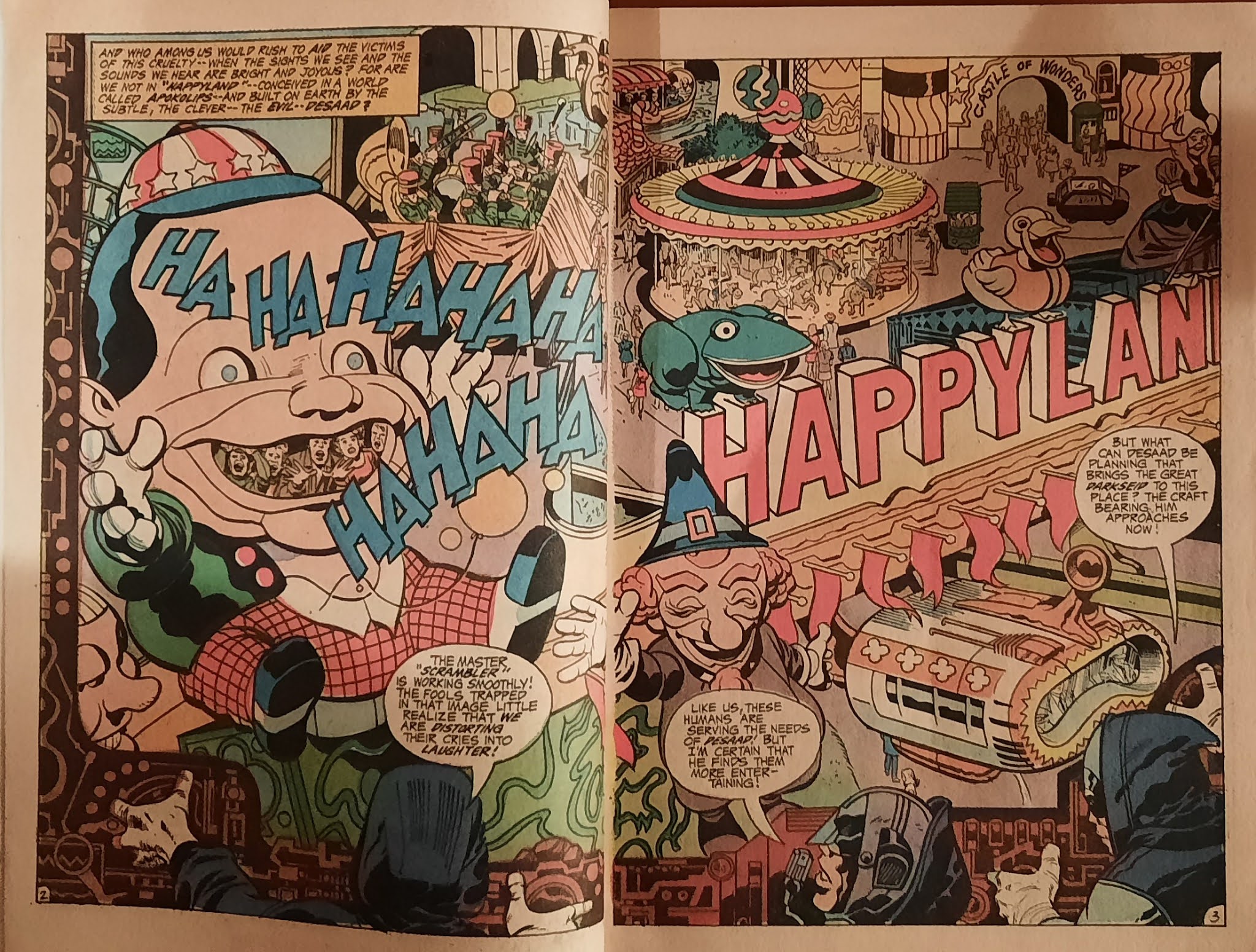
Forever People # 4, published 50 years ago today, 1 June, 1971, opens with the screaming, parched, desperate denizens of Desaad’s colourless blue Kingdom of the Damned, a deathly Disneyland, called ‘Happyland’. Those who are trapped behind its one-way prison glass include the Forever People. It is not for them to walk leisurely through its happy surrounds and absorb its safe, 1950s perfect world. They are stuck, they are its tormented inmates who are ignored and their voice is not heard.


Desaad, agent of the Apokloliptian State, uses a ‘master scrambler’ to turn the damned’s cries into laughter, their desperation into amusement, their pleas for order into threats. The chilling image of the humpty dumpty figure, with an American flag cap who has a passing resemblance to Nixon, with the voices of the desperate silenced, their cries turning to ashes in their mouths, is like an image of the madness of society trying to carry on as if nothing is happening in Vietnam, nothing is happening in the streets, all is calm like a silent Christmas night, like a Don Rickles comedy special after watching 30 US soldiers get killed by a PAVN 122mm rocket hitting their bunker at Charlie 2³ or seeing 12,000 of your friends get arrested in the May Day protests.⁴

The two ways of seeing the world, the State’s and the counterculture’s were at war and Kirby reflects this conflict in his stories. The incredulity on both sides, how can you believe that, how can you think or do that? Mark Moonrider pleads with the straights who look at him through the glass, from his ‘unbreakable, transparent, cage’: “Help! You out there! Help me! What’s wrong with you?...Why do you just sit and stare?’’ The occupants of the amusement ride, under- the-boardwalk- era clothes and countenance, only see a skeleton howling thanks to Desaad’s scrambler, they see media-created caricatures, like their real-world counterparts on the San Francisco bus tours.  


It’s not the world that is different, it is the way you see it. Your feelings, your awareness changes, what once satisfied, what once made sense, now no longer does, ‘a happy place, turned into hell.’ The non-violent Forever People don’t want revolution, they want to communicate, they want people to hear, to understand. Their strength is in their vulnerability as in previous issues where they connect with outcasts, youth, the crippled. You want them to fight back physically but they don’t or won’t.⁵ The Forever People try to change people’s hearts and they suffer for it.

Our heroes are up against an ideology, an all-encompassing anti-life that won’t be reached by the mind, the voice, the heart. In June, 1971, the Forever People and the counter-culture look like they are on the ropes. Yet there is hope. Their lost mother box resists Desaad’s destruction, Serifan alone has the strength to defy Desaad and on the horizon, Sonny Sumo, the Banzai Express chances upon the suddenly materialised mother box and hears it calling out his name for help.

In one of the issue's mini posters after the story’s end, Kirby foreshadows the future, ‘Beautiful Dreamer versus Darkseid! Both hold the key to victory in the strangest war ever fought in comicdom’s history!’

As Beautiful Dreamer lies still beset by Desaad’s nightmares, she like the rest of the Forever People awaits the Mother Box’s call of deliverance. The dream is still alive, through the Looking Glass, someone will see, someone will hear, ‘….carry on, love is coming, love is coming to us all….’.⁶

¹A tour company organised a bus trip around San Francisco’s hippy areas in 1967, the same year as the Summer of Love, billing it ‘the only foreign tour in the domestic United States’, Video of the tour appeared in PBS’ documentary, ‘Summer of Love’

²From Jack Kirby Collector # 24, page seven, April, 1999.

³30 U.S. infantrymen, many from Company A, 1st Battalion, 61st Infantry Regiment, were killed when a PAVN 122mm rocket hit their bunker at Charlie 2 on 21 May, 1971. Source: Veterans of Foreign Wars Magazine, May 2011.

⁴From the New York Times, May 6, 1971, page one.

⁵Kirby deliberately made the Forever People non-violent. ‘The Forever People are non-violent. The Forever People are a challenge to comics, because although they engage in violent activities, they never fight…I don’t feel you have to show blood and gore and guts. I think it’s repellent. I’ve seen enough of it in reality….’ From an interview originally published in Train of Thought # 5, 1971, reprinted in Jack Kirby Collector # 17, November, 1997.

⁶From the lyrics to ‘Carry On’ by Crosby, Stills, Nash and Young. The live version had come out on the double-live album, 4 Way Street, released in April, 1971.

Research this article:                                           

Comics:

-Comics Journal # 134, February 1990 (Jack Kirby interview by Gary Groth)

-Jack Kirby Collector # 17, November 1997 and # 24, April 1999

-Mike’s Amazing World of Comics website

-The Indispensable Kirby & Lee: Stuf’ Said! (Jack Kirby Collector # 75: TwoMorrows).

Popular culture:

-Helter Skelter, the True Story of the Manson Murders (Vincent Bugliosi with Curt Gentry, W.W. Norton, 1994)

-There’s A Riot Going On (Peter Doggett, Canongate, 2007)

-Uncovering the Sixties (Abe Peck, Pantheon, 1985) .

Michael Mead is a 54-year-old New Zealand comic book collector, who likes to think he can do "contextual" commentary reviews of old comics, asking: "where does this story come from?", looking at the social, political, cultural times it came from, the state of the comics industry, the personal and creative journey of the writer or artist, the personal journey of the reader as a child and as an adult. 

As part of this, he is vain enough to think he can bring new insights into Kirby's Fourth World comics and so, on the 50th anniversary of publication of each issue of Superman's Pal Jimmy Olsen, Forever People, New Gods and Mister Miracle, he will publish a contextual commentary. Check out his earlier entries on this blog and tell him to stop talking so pretentiously in the third person for God's sake! 


Tuesday, May 25, 2021

Is that a landmine in your lunchbox?


Jimmy Olsen # 139 (July, 1971), published 50 years ago today, is like that joke your Dad tells over and over because he thinks it’s funny and you think it’s lame. Somehow though, it lodges itself in your brain and then you see there’s something more to it. Something you rushed past in your youthful cringe, something he’s slipped in there, like a time capsule that goes ping at a pre-determined time, when you’re ready to see it and when you open the contents, when you unscrew the top of that 1950s metal jar he stuck in the ground, you suddenly see a childhood moment with adult eyes.

In this case that Dad is Jack Kirby’s version of the ‘Merchant of Venom’, ‘insult’ comedian Don Rickles or to be more accurate his lookalike ‘Goody Rickles’, one of Morgan Edge’s research staff at Galaxy Broadcasting Service. National/DC decided to showcase the real Don Rickles, who was riding high with a successful comedy album, TV show and appearance in a prominent movie¹, in two issues of Jimmy Olsen to help promote the comic. Rickles gave his permission for a brief appearance and then felt exploited by National’s fulsome use of his likeness, later disowning the comics.²

Kirby’s treatment of Goody Rickles in Jimmy Olsen # 139 is almost pure comedy. It’s an unexpected change of pace from the main storyline, Morgan Edge’s involvement with Darkseid and Inter-Gang. So it’s unsurprising that readers then and since have panned the two issues. It’s easy to agree with letter-writer Gerald Triano, that Jimmy Olsen “….is being used as a supplement to Mr Kirby’s trilogy of mags, and nothing more.”

Yet there are some very funny moments including Edge’s murderous exchanges with Goody which are like a straight man/funny man stand-up routine, and some pointed satire. As my one-time comic-reading sister said to me when she was reading these commentaries, Kirby is amazingly subversive with a youthful audience. The kind of material, issues, ideas he is exploring, eyeline straight into the brain, heart and consciousness of a child, unnoticed by the contemporaneous adult world and then instantly stand out when that child reader gets old.

The first bit of text on the cover is: “Are you ready for defoliants in your succotash? Are you ready for landmines in your lunchbox?” Vietnam worsening, no end in sight, the counterculture’s final big push, the May Day 1971 protests at Washington D.C. over and each night, over dinner, or at lunch at school, images flashing before your eyes of young men dying, Agent Orange defoliant billowing across the screen, violence on domestic streets, anger and dissent, bitter generational conflict.

The juxtaposition of Kirby’s words mirror the compartmentalisation in society that was happening at the time. The jarring nature of such an all-encompassing conflict expressed as entertainment  ‘up next, more death in Vietnam, followed by the Don Rickles comedy hour, only on ABC!’ It’s like Kirby is saying, ‘this is what they’re serving up to you, are you going to swallow this?’ Jimmy Olsen # 139 follows on the aerodisc heels of Mister Miracle # 3 whose cover copy told readers about the paranoid pill and said ‘buy it, don’t swallow it!’

Kirby’s subversion continues in the vein of his signature Fourth World satire from Forever People # 3, the Glorious Godfrey issue. There’s a cynicism to the lines he feeds Goody, as the costumed researcher veers from slapstick, cornball, physical comedy to undermining authority, puncturing dreams. Goody hugs, mock punches Edge and then the agent of Apokolips becomes frustrated with the Rickles doppelganger: “(Edge) Walter Cronkite won’t get it! Truman Capote won’t get it! But you! – Goody Rickles! You’re going to get it! (Goody) It’s like John Wayne says! The American dream—it works! You just have to eat apple pie and believe!”

These aren’t sentiments your average eight- year- old reader would be used to reading. In its own way it’s a negative nod to the big red S, the idealistic State symbol of everything good, the super dream of truth, justice and the American way. Kirby features Superman prominently in Jimmy Olsen and undermines what he represents at the same time. Not everybody makes it, barriers are there for some but not for others.

The ‘landmine in your lunchbox’ is not a stink bomb put there by one of your friends, it’s not a literal bomb from a B-52, it’s the realisation that despite all the good intentions from others, all your fervent beliefs, things might not be as they seem, things may not work out for you, after all. The joke is an ugly truth. Are you ready for this?

¹Don Rickles was a nationally-know comedian, a peripheral member of Frank Sinatra's Rat Pack with a long list of screen credits. His 1968 comedy album, 'Hello, Dummy!' charted to a high of # 68 in the Billboard top 200 charts. In the same year ABC gave him a variety show which lasted one season. In 1970, Rickles had a notable role in the film Kelly's Heroes, sharing billing with co-stars Clint Eastwood, Telly Savalas, Donald Sutherland and Carroll O'Connor. 

²From Mark Evanier’s ‘News From Me’ website blog, Sunday May 21, 2017 at 1.48pm.

Research this article:                                           

Comics:

-Comics Journal # 134, February 1990 (Jack Kirby interview by Gary Groth)

-Mike’s Amazing World of Comics website

-The Indispensable Kirby & Lee: Stuf’ Said! (Jack Kirby Collector # 75: TwoMorrows).

Popular culture:

-Helter Skelter, the True Story of the Manson Murders (Vincent Bugliosi with Curt Gentry, W.W. Norton, 1994)

-There’s A Riot Going On (Peter Doggett, Canongate, 2007)

-Uncovering the Sixties (Abe Peck, Pantheon, 1985) .

Michael Mead is a 54-year-old New Zealand comic book collector, who likes to think he can do "contextual" commentary reviews of old comics, asking: "where does this story come from?", looking at the social, political, cultural times it came from, the state of the comics industry, the personal and creative journey of the writer or artist, the personal journey of the reader as a child and as an adult. 

As part of this, he is vain enough to think he can bring new insights into Kirby's Fourth World comics and so, on the 50th anniversary of publication of each issue of Superman's Pal Jimmy Olsen, Forever People, New Gods and Mister Miracle, he will publish a contextual commentary. This is his 16th Fourth World commentary. Check out his earlier entries on this blog and tell him to stop talking so pretentiously in the third person for God's sake!  

Tuesday, May 18, 2021

Paranoia in, peace out, the Miracle pill


‘I need someone to show me

The things in life that I can't find

I can't see the things that make

True happiness, I must be blind


Make a joke and I will sigh

And you will laugh and I will cry

Happiness I cannot feel

And love to me is so unreal


And so, as you hear these words

Telling you now of my state

I tell you to enjoy life

I wish I could but it's too late.’

 (Paranoid, Black Sabbath, 1970)¹


Did you have a moment, when it all started slipping away, when you lost hope, when you couldn’t trust anymore, when you became unmoored so far away from anything you yearned for and nothing was as it seemed? Is that when you took the Paranoid Pill? The occupants of Chandler Towers have no choice as they inhale the pill’s vapours and turn into ‘5,000 raving maniacs’ bent on destroying Scott Free in Mister Miracle # 3 (August, 1971), published 50 years ago today.

The predicament Jack Kirby put his super escape artist in via Apokolips’ Dr Bedlam, reflected the feelings some of his readers would have had. Paranoia was widely felt by countercultural youth at the time and with good reason.

From The Ring Magazine Muhammad Ali Special, 2016 pp. 79

On March 8, 1971, on the same night as Muhammad Ali fought Joe Frazier in New York in the ‘Fight of the Century’ with millions of people listening to radios or watching in theatres, the Citizen’s Commission to Investigate the FBI broke into an FBI office outside Philadelphia and stole 800 documents which showed the Government was spying on black and student groups.²

From Time Magazine, 5 April 1971, pg. 15

The Commission released the papers to the New York Times, Los Angeles Times and Washington Post. In June, 1971, the New York Times would publish the ‘Pentagon Papers’ showing how successive American administrations had lied to the public about Vietnam.

Paranoia isn’t bound by history. It comes at us in all times and places when we are at our lowest, when we feel cut off from our natural community, when we feel ‘other’, separate, strange, when we begin to believe happiness, love, is only for other people. Life hasn’t delivered for us and it can drive despair as equally as rage. For some it leads to faith in demagogues such as Glorious Godfrey and Dr Bedlam who play on the grievance paranoia brings, who say there is someone to blame.

Unlike Godfrey, Dr Bedlam doesn’t persuade and delude by words, he doesn’t invite his followers to fool themselves, he simply drugs them with his paranoid pill and lets its vapours blow the top off of their underlying fears, enmities, delusions. Scott Free’s fight against these ‘maniacs’ is like a journey from the unconscious (top floor) to the conscious (bottom floor) as Bedlam sets him the task of getting out of Chandler Towers alive.

Bedlam is Kirby’s rumination on the effects of evil. The bad doctor is only an elemental force until he can inhabit an ‘animate’, until his evil can be given life. Bedlam can only enter a blank slate, a being who has lost the spark behind the eyes, whose pupils are deadened, whose life and actions have corroded their soul, a human husk. 

The animates are like Alison Bechdel’s father, who lived a double life, in her graphic novel about her life, ‘Fun Home.’ To be around him was like being ‘…in the presence of an absence.’ ³ Evil is not a devil, it is not creative, it is anti-life, the absence of good. Invited in, it hollows out the good and leaves only emptiness, it can only animate a lifeless form.

Scott Free faces this kind of evil with Apokolips. If anyone has the right to feel paranoid, it is Mister Miracle. Targeted by Darkseid and Apokolips from birth, abused in Granny’s terror orphanage, constantly looking over his shoulder for the next evil menace, a ‘full second’ from death in traps he willingly puts himself in, he escapes as Mister Miracle because he has seen his fears, he has accepted where they come from and what he must do about it. Like Kirby’s advice to the reader on the front cover of Mister Miracle # 3, ‘Buy it! But don’t swallow it!’ Yes there is chaos, there is fear, there is mania but we don’t have to consume it.

Scott Free hasn’t pushed fear away, he hasn’t run from paranoia, he has let it in to see it, to know it, to prevail over it. “….You can’t visualize the kind of enemy we face unless you truly experience the effects of its power.” Unlike Dr Bedlam’s poor, innocent, victims, who walk on the poisoned ground Bedlam lays down and become infected, Scott’s childhood terrors have inoculated him, built up his immunity, he stares clear-eyed into the abyss and comes out unscathed, because he has already been there.

Facing a vanishing point death at the end of the issue, he seems in an inescapable physical trap but you know he will win because his mind is free. He has found happiness, he has felt love, it’s never too late for Mister Miracle.


‘It don't come easy,

You know it don't come easy.
It don't come easy,
You know it don't come easy.

Got to pay your dues if you wanna sing the blues,
And you know it don't come easy.
You don't have to shout or leap about,
You can even play them easy.

Open up your heart, let's come together,
Use a little love
And we will make it work out better,

I don't ask for much, I only want your trust,
And you know it don't come easy.
And this love of mine keeps growing all the time,
And you know it don't come easy.

Peace, remember peace is how we make it,
Here within your reach
If you're big enough to take it.’

(Ringo Starr, It Don’t Come Easy, # 8 on the Billboard top 100 in the week of 22 May, 1971)


¹Black Sabbath’s Paranoid album was released in the United Kingdom (UK) in September 1970 and went to # 1. The eponymous single was released at the same time and reached number # 4 in the UK charts. In January 1971, the Paranoid album was released in the United States (US), debuted on the Billboard top 200 at # 25 in the week of February 20, 1971 and rose as high as # 12 in the week of March 20, 1971. The US single debuted at # 94 in the week of November 28, 1970 but only reached a high of # 61 in the week of 26 December, 1970.

²Time Magazine, 5 April, 1971, pg.15.

³From Tom Crippen’s review of Alison Bechdel’s Fun Home, The Comics Journal # 278, October 2006, pg. 154.

Research this article:                                           

Comics:

-Comics Journal # 134, February 1990 (Jack Kirby interview by Gary Groth)

-Comics Journal # 278, October 2006

-Fun Home, Alison Bechdel, First Mariner Books, 2007

-Mike’s Amazing World of Comics website

-The Indispensable Kirby & Lee: Stuf’ Said! (Jack Kirby Collector # 75: TwoMorrows).

Popular culture:

-Helter Skelter, the True Story of the Manson Murders (Vincent Bugliosi with Curt Gentry, W.W. Norton, 1994)

-There’s A Riot Going On (Peter Doggett, Canongate, 2007)

-Time Magazine, 5 April, 1971

-Uncovering the Sixties (Abe Peck, Pantheon, 1985) .

Michael Mead is a 54-year-old New Zealand comic book collector, who likes to think he can do "contextual" commentary reviews of old comics, asking: "where does this story come from?", looking at the social, political, cultural times it came from, the state of the comics industry, the personal and creative journey of the writer or artist, the personal journey of the reader as a child and as an adult. 

As part of this, he is vain enough to think he can bring new insights into Kirby's Fourth World comics and so, on the 50th anniversary of publication of each issue of Superman's Pal Jimmy Olsen, Forever People, New Gods and Mister Miracle, he will publish a contextual commentary. Check out his earlier entries on this blog and tell him to stop talking so pretentiously in the third person for God's sake! 


Let the doors to eternity fly open, there is another way

  ‘Over the carnage rose prophetic a voice, Be not dishearten'd—Affection shall solve the problems                               of F...