Tuesday, August 3, 2021

Feel the pain, heal the wound, live again


‘I can think of younger days when living for my life

Was everything a man could want to do
I could never see tomorrow
But I was never told about the sorrows

And, how can you mend a broken heart?
How can you stop the rain from falling down?
How can you stop the sun from shining?
What makes the world go round?
How can you mend this broken man?
How can a loser ever win?
Please help me mend my broken heart and let me live again.’

(How Can You Mend A Broken Heart, Bee Gees, 1971)¹

Sonny Sumo sees the wounds that no else sees because he has lived the life of a Samurai warrior, he has seen the signs, he knows what to look for, he sees past the surface and deep into the body, mind, soul.  His ritual of ‘wound rejection’ is not just about physical healing, it is about transcending the emotional damage to the spirit. 


Aided by the Motherbox, Sonny is the man to mend the broken hearts of the Forever People, to restore the youthful hippie avatars to life, to lift the non-violent visitors from New Genesis from sorrow to winning with kindness, in Forever People # 5 (November, 1971), published 50 years ago today, 3 August, 1971.

Stuck in Desaad’s ‘Happyland’ since last issue, they writhe in tailored torment, each torture designed by Desaad to drive at the particular pain of Mark Moonrider, Big Bear, Beautiful Dreamer, Serifan and Vykin the Black. Desaad loves pain, like Charles Manson he gets off on watching the vulnerable suffer.² The intensity of his enjoyment of fear is akin to an orgasm and it distorts his face in half-human pleasure.

Desaad, like the believer in Helter Skelter and his inspiration, the leader of the Process/The Church of the Final Judgement, Robert de Grimstone (Robert Moore), surgically dismantles his target’s personalities. He looks for weak points, for people who are down or believe the best in others. Desaad and his twisted real-world counterparts deliver them the worst. Like all bullies their inability  to deal with their own pain inspires them to inflict it on others through fear:

“Fear is beneficial…Fear is the catalyst of action. It is the energiser, the weapon built into the game in the beginning, enabling a being to create an effect upon himself, to spur himself on to new heights and to brush aside the bitterness of failure.”³


Desaad


Charles Manson


Robert de Grimstone/Robert Moore

The threat posed by someone genuinely happy fills Desaad with fear because he has long since stopped believing in it. ‘Happyland’ is his response, false façade and the reality he embraces inside, both in himself and in his torture chambers. Happiness is a Big Lie and his job is to undermine each of the Forever People by taking away their greatest strength, so they admit it.

Mark Moonrider struggles to escape his glass cage, the leader of the Forever People exposed as a skeleton, no flesh on his bones, no substance to his leadership as the theme park cruisers literally see through him. Sonny Sumo sees through the Looking Glass and smashes the perceptions of those watching to reveal the true self.

Big Bear, the strongest of the Forever People is made weak by constant hammering shots to the body. Sumo rips off the fourth world wall and the audience sees the real person behind it. 

Beautiful Dreamer, the serene beauty who brought peace to all, is made afraid of all by the monsters in her constant nightmares. Sonny and Motherbox give her sight and her smile returns.

Serifan the child, the youngest, most vulnerable of the Forever People must constantly kick a lever or his friend Vykin the Black will die and Serifan will be alone and responsible. Motherbox frees the enslaved black Vykin from his bonds and both are again, free.

Broken hearts mended, sorrow lifted, wounds healed and a successful battle with Desaad’s ‘faithful’. Kirby then comes with the revelation: Sonny Sumo knows the anti-life equation! ‘The very opposite of living….absolute control over you…without independent will.’  That makes him Darkseid’s target and the Forever People join forces with him to stop the Master of Apokolips and just live their way.

The issue closes with a stunning, self-aware remark from Darkseid who almost evokes sympathy from the reader. Responding to seeing Sumo has the anti-life equation and to the Forever People’s remarks, he says  ‘…I must admit they have a point. We must be what we are. And of course – that’s the pity of it. It’s the very core of our conflict. To fulfil ourselves, we must kill them!’ Darkseid’s evil and the Forever People’s goodness seems pre-destined. 

Darkseid is a broken man who will never be mended. The Forever People will see tomorrow, marked by pain and wound but believing always, in each other, living again.

¹The Bee Gees song, ‘How Can You Mend A Broken Heart’  from the album ‘Trafalgar’ was their first US number #1 hit, making the mark in the same week as Forever People # 5 was published.

²Charles Manson rarely participated in his followers’ activities. He was a voyeur who liked to direct orgies, drug-taking, violence and then watch. Manson organised the Tate-La Bianca murders in August 1969 but was not present. His followers killed for him.

³As quoted in Bugliosi, pg. 612, from a special issue of The Process magazine. Bugliosi interviewed Manson after his conviction on June 14, 1971 and asked him directly about the connection to the Process/Church of the Final Judgement. It followed an earlier conversation during the Tate-LaBianca trial where Manson denied knowing de Grimston/Moore. Two of deGrimston’s followers visited Bugliosi and assured him Manson and de Grimston had never met. They had earlier visited Manson in jail. The Process’1967 HQ in San Francisco, was only two blocks from where Manson lived after leaving jail in the same year (pg. 611). The Process and Manson’s beliefs were similar and Bugliosi concluded Manson heavily borrowed’  from de Grimston. This is the same conclusion reached by the recent Sons of Sam Netflix series on David Berkowitz et al who were influenced by the Process.

 Research this article:                                          

Comics:

-Comics Journal # 134, February 1990 (Jack Kirby interview by Gary Groth)

-Mike’s Amazing World of Comics website

-The Indispensable Kirby & Lee: Stuf’ Said! (Jack Kirby Collector # 75: TwoMorrows).

Popular culture:

-Helter Skelter, the True Story of the Manson Murders (Vincent Bugliosi with Curt Gentry, W.W. Norton, 1994)

-There’s A Riot Going On (Peter Doggett, Canongate, 2007)

-Uncovering the Sixties (Abe Peck, Pantheon, 1985) .

Michael Mead is a 55-year-old New Zealand comic book collector, who likes to think he can do "contextual" commentary reviews of old comics, asking: "where does this story come from?", looking at the social, political, cultural times it came from, the state of the comics industry, the personal and creative journey of the writer or artist, the personal journey of the reader as a child and as an adult. 

As part of this, he is vain enough to think he can bring new insights into Kirby's Fourth World comics and so, on the 50th anniversary of publication of each issue of Superman's Pal Jimmy Olsen, Forever People, New Gods and Mister Miracle, he will publish a contextual commentary. This is his 21st Fourth World commentary. Check out his earlier entries on this blog and tell him to stop talking so pretentiously in the third person for God's sake! 


Tuesday, July 13, 2021

A natural woman for a miracle man


Big Barda is the Germaine Greer of superheroines, there is no doubt about who she is and what she wants and no man is going to tell her what to do. Her debut in Mister Miracle # 4 (October, 1971), published 50 years ago today, 13 July, 1971, is epochal. At a time when women did not have equal rights, Big Barda decided her own and in her journey with Mister Miracle, she provided him the ‘maximum’.

Like her real-world contemporaries, Mary Tyler Moore, Carole King, Angela Davis, she expresses herself as she truly is, no small feat for a woman in 1971 in our world or hers. Like Greer’s 1990s remembrance of her hugely influential book, the Female Eunuch (1970)¹, Barda wants to live with the ‘…freedom to be a person, with dignity, integrity, nobility, passion, pride that constitute personhood. Freedom to run, shout, talk loudly and sit with your knees apart. Freedom to know and love the earth and all that swims, lies, and crawls upon it.’²

Barda is no fanboy, fetishistic, fantasy-engineered, cos-play, lust object. She is a proper woman in the best and fullest sense. Straight out of Kirby’s favourite Marilyn Munro physical form playbook, she is big in all senses, a big body, which she is entirely comfortable with and bigger than life. The total opposite to the prevailing late period, counter-culture, idealised female form, the thin, leggy, rock trophy waif wife Bianca Jagger (then recently-married to tax exile Mick) or the earlier mid-60s Twiggy.

Barda is representative of second wave feminist women who challenged the patriarchal revolution, that power to the people’ includes women.³ I can see her rounding up the brainwashed Manson supplicant succubuses like Squeaky Fromme who still roamed Kirby’s Los Angeles streets, and packing them off to a work camp.  ‘I’ve no time to cuddle your neuroses!’

Scott Free’s pararmour is military. She is a soldier in Darkseid’s army. Barda helped Scott escape from Granny Goodness’ terror orphanage where they were both imprisoned yet she did not leave. She has a bond with Mister Miracle that spans the years and the two of them exemplify many qualities opposite to the traditional gender roles of the time.

Barda is earth to Scott’s spirit, she is strength to his subtlety, size to his slim form, warrior to his priest, ground to his flight, passion to his intellect, action to his thought. In many ways Barda is more ‘man’ and Scott is more ‘woman’. In the humble pages of a then throwaway medium, Kirby is subverting the expectations of the superhero comic audience, he is, as usual, reflecting his times. Without fully realising it, the two characters are being made for each other, they are two proud people who need the other but are only just beginning to see it.

The two of them take moments to teach the other about how they have changed since they last met. Barda stands her ground about her decision to stay at Granny’s and not do what Scott told her to and escape with him (‘Yes, perhaps I should have…but I stayed—to become..what I am.’). Scott pulls Barda up on her reaction to Oberon’s dig after the Kirby avatar has sized her up and reckoned Mister Miracle would be better off without the female warrior. Barda goes full army and says ‘The little rat—he needs a disciplined tongue!’ Scott counters, ‘This is a house of friends, Barda! The strong don’t rule here!’

Scott, the abused child, sees no justice in distorted discipline, no gain in inflicting more pain. His is a New Genesis message of vulnerability, acceptance, freedom, love, reconciliation, qualities more often associated with women. Barda is all consequence, action, punishment, traits traditionally associated with men and practiced to perfidy perfection on Apokolips.

Like John Sinclair of the White Panthers⁴ or John Lennon however, Scott Free has some way to go on the road to female equality. Finished with explaining how he escaped Doctor Bedlam’s trap and 5000 raving maniacs where we left him last issue, the clever, scientific, detached, sensitive miracle man, dressed in an apron while cooking a meal for her, another role reversal many readers would not have seen at the time at home or in popular culture, patronisingly remarks, ‘Oh Barda’s all right. She’s just a child, you know. A powerful, deadly child playing soldier.’

Behind him, Barda has shed her military uniform and has stripped down to her undergarments, which upon seeing her, causes the boys to exclaim, (Scott) ‘I take it back Oberon! That’s a big, beautiful woman playing soldier. (Oberon) ‘Whoever made that gal wear a uniform should be horse-whipped.’

There is no sense here that Kirby is pandering to the reader. Barda’s clothing decision is completely in character. The battle is over, she’s back in the barracks and someone’s cooked good food. She’s just showing the freedom to run, talk loudly and sit with her knees apart. Her sexuality is not simply located in her body, it’s in how she carries herself, how she relates to her community, to her friends, to her mission.

Like all good relationships, the Barda-Miracle dance is one of strong wills and revelations, disagreements and surprises. Big Barda sets Scott, free, in so many ways (and vice versa). She is a natural woman for a miracle man.

‘When my soul was in the lost and found

You came along to claim it
I didn't know just what was wrong with me
'Til your kiss helped me name it
Now I'm no longer doubtful, of what I'm living for
And if I make you happy I don't need to do more

'Cause you make me feel
You make me feel
You make me feel like a natural woman (woman).’

Carole King, from her 1971 album, Tapestry, released 10 February, 1971


¹The Female Eunuch by Greer debuted to ‘mixed reviews’ in 1970 but soon became a feminist classic. By March, 1971 it had almost sold out its second printing. In July 1971, Eunuch was number # 3 on Time Magazine’s non-fiction bestseller list. Time Magazine 5 July, 1971, pg. 60.

²Greer, Germaine (1993). The Female Eunuch. London: Flamingo. p.11.

³Yoko Ono helped bring about John Lennon’s realisation of his sexism in 1971. Lennon said ‘how can you talk about power to the people unless you realise the people is both sexes?’ Ono completed the lesson, ‘…if you are a slave around the house, how can you expect to make a revolution outside it?’ Doggett, pg 422.

⁴Formerly macho leader of the White Panthers John Sinclair underwent a revelation in jail and denounced her own ‘persistent sexism’ in a June 1971 bulletin, ‘Free Our Sisters/Free Our Selves!’ Doggett, pg. 421.

Research this article:                                           

Comics:

 -Comics Journal # 134, February 1990 (Jack Kirby interview by Gary Groth)

-Mike’s Amazing World of Comics website

-The Indispensable Kirby & Lee: Stuf’ Said! (Jack Kirby Collector # 75: TwoMorrows).

Popular culture:

-Helter Skelter, the True Story of the Manson Murders (Vincent Bugliosi with Curt Gentry, W.W. Norton, 1994)

-There’s A Riot Going On (Peter Doggett, Canongate, 2007)

-Time Magazine, 5 July, 1971

-Uncovering the Sixties (Abe Peck, Pantheon, 1985) .

Michael Mead is a 55-year-old New Zealand comic book collector, who likes to think he can do "contextual" commentary reviews of old comics, asking: "where does this story come from?", looking at the social, political, cultural times it came from, the state of the comics industry, the personal and creative journey of the writer or artist, the personal journey of the reader as a child and as an adult. 

As part of this, he is vain enough to think he can bring new insights into Kirby's Fourth World comics and so, on the 50th anniversary of publication of each issue of Superman's Pal Jimmy Olsen, Forever People, New Gods and Mister Miracle, he will publish a contextual commentary. This is his 20th Fourth World commentary. Check out his earlier entries on this blog and tell him to stop talking so pretentiously in the third person for God's sake! 


Thursday, July 8, 2021

Kirby's wonderful world rickles with madness


At the time of the greatest climax in the counter-culture’s war against the State, Jack Kirby gave us….double Rickles. To be more precise, Goody and Don because one Rickles deserves another. And no Superman because, well, Superman isn’t funny. Kirby’s second, comedic, rollicking Rickles tale in Jimmy Olsen # 141 (September, 1971), published 50 years ago today, 8 July, 1971, is another opportunity to put the ‘Merchant of Venom’, insult comedian Don Rickles, into the Fourth World. He features prominently on the cover and to the bemused reader, Kirby’s invitation is simply, ‘Don’t ask! Just buy it!’

Taken together, the two Don Rickles issues (see my commentary on Jimmy Olsen # 139, # 140 is an all-reprint giant size comic) are like an extended Dad joke. Only this time you get to go to the office with Dad, like those times at school when you’d write a book report the next day which said something like ‘my Dad sits at a desk and types and it seems very boring’ (hint: the school system does this to prepare you for your adult life, remember?). When Don Rickles visits the office though, beautiful girls love being insulted by him (I’ve never found this a workable seduction technique), middle-aged men act like man-love groupies and want his autograph ‘write something weird and nasty!’ (again, preparation for the resident office sociopath, every office has one).

The focus of Kirby’s Fourth World is on the youth reader but in the two Don Rickles issues he shows the child reader the Parent World. It’s as if Kirby has sealed off the comic from the outside world, while the other three titles prominently feature hippie avatars and their concerns and savagely satirise public figures.

Outside Jimmy’s pages, in the weeks leading up to publication, Woodstock nation rushed towards its greatest climax, it had proved the Government had been spying on them¹ and a 40-year-old strategic analyst and friend to the Movement, Daniel Ellsberg (you can trust someone over 30), had leaked top secret government papers showing the Government had been lying to Americans about Vietnam.²

From Time Magazine, 5 July, 1971, pg. 13

The two revelations came at exactly the right time for the Movement, brought low by Kent State a year earlier and seemingly out of gas after the last big, anti-Vietnam War demonstrations in May, 1971.  The impact of the Pentagon Papers, showing untruths across multiple Republican and Democrat administrations, went right to the top. Nixon’s chief of staff H.R. Haldeman repeated a colleague’s point:

‘To the ordinary guy, all this is a bunch of gobbledygook. But out of the gobbledygook comes a very clear thing.... You can't trust the government; you can't believe what they say; and you can't rely on their judgment; and the – the implicit infallibility of presidents, which has been an accepted thing in America, is badly hurt by this, because It shows that people do things the president wants to do even though it's wrong, and the president can be wrong.’³

From Time Magazine, 5 July, 1971, pg. 13

The juxtaposition of the other three Fourth World titles and the two Rickles issues of Jimmy and the difference between what is happening within the pages versus what is happening outside them, is jarring. It’s a kind of madness reflected in the growing mental instability of Don Rickles, like a symbol of the establishment parent, who starts off with his insult jokes, becomes increasingly irritated and by the end of the story is literally carried off stage by men in white coats, unable to reconcile what he is hearing with what he is seeing.

Morgan Edge tries to calm people down after the explosive threat of Jimmy and the New Guardian’s ingestion of the chemical pryo-granulate has been neutralised, ‘We did have an emergency here! But it was brought under control!’ Don Rickles responds: ‘That’s a lie! I’m the bomb! And I’m primed to blow! Get me outta here! Stop me from killing!’ It’s like two sides of the State, one moving to acknowledge something has gone wrong and wanting to reassure the populace that the system is OK, the other warning that everything is going to fall apart.

Superman, the State saviour, is shuffled off stage in this issue. He meets Lightray for the first time but as Clark Kent (you never see him in costume within the issue), returning at the end via Boomtube, his loud entrance serving as the final insult to send Don Rickles over the Edge.  

Reading this issue, you might feel the same, it might drive you bananas, you might feel like you are on the ropes but hey, this is Kirby! It’s a wonderful world. Just listen to ol’ Pops.

‘Some of you young folks been saying to me," Hey Pops, what you mean 'What a wonderful world'? How about all them wars all over the place? You call them wonderful? And how about hunger and pollution? That ain't so wonderful either."

Well how about listening to old Pops for a minute. Seems to me, it ain’t the world that's so bad but what we're doin' to it. And all I'm saying is, see, what a wonderful world it would be if only we'd give it a chance. Love baby, love. That's the secret, yeah. If lots more of us loved each other, we'd solve lots more problems. And then this world would be a gasser.

That's wha' ol' Pops keeps saying."

I see trees of green, red roses too
I see them bloom, for me and you
And I think to myself
What a wonderful world….’

From the lyrics to It’s A Wonderful World (spoken version) by Louis Armstrong, 1970. Armstrong would pass away two days before Jimmy Olsen # 141 hit the stands, on 6 July, 1971.

¹On March 8, 1971, on the same night as Muhammad Ali fought Joe Frazier in New York in the ‘Fight of the Century’ with millions of people listening to radios or watching in theatres, the Citizen’s Commission to Investigate the FBI broke into an FBI office outside Philadelphia and stole 800 documents which showed the Government was spying on black and student groups. Time Magazine, 5 April, 1971, pg.15.

²The New York Times first published excerpts from the Pentagon Papers on 13 June, 1971, followed by the Washington Post, five days later. The US Government sought an injunction to stop publication of the material but in a 6-3 Supreme Court decision on 30 June, 1971, the court found the Government had not met the heavy burden on proof for the injunction.

³From Eddie Meadows’ June 14, 1971 transcript "Oval office meeting with Bob Haldelman, Nixon Presidential Materials Project, Oval-519-, Cassette 747"audio tape.

Research this article:                                           

Comics:

-Comics Journal # 134, February 1990 (Jack Kirby interview by Gary Groth)

-Mike’s Amazing World of Comics website

-The Indispensable Kirby & Lee: Stuf’ Said! (Jack Kirby Collector # 75: TwoMorrows).

Popular culture:

-Helter Skelter, the True Story of the Manson Murders (Vincent Bugliosi with Curt Gentry, W.W. Norton, 1994)

-There’s A Riot Going On (Peter Doggett, Canongate, 2007)

-Time Magazine, 5 July, 1971

-Uncovering the Sixties (Abe Peck, Pantheon, 1985) .

Michael Mead is a now, 55-year-old New Zealand comic book collector, who likes to think he can do "contextual" commentary reviews of old comics, asking: "where does this story come from?", looking at the social, political, cultural times it came from, the state of the comics industry, the personal and creative journey of the writer or artist, the personal journey of the reader as a child and as an adult. 

As part of this, he is vain enough to think he can bring new insights into Kirby's Fourth World comics and so, on the 50th anniversary of publication of each issue of Superman's Pal Jimmy Olsen, Forever People, New Gods and Mister Miracle, he will publish a contextual commentary. This is his 19th Fourth World commentary. Check out his earlier entries on this blog and tell him to stop talking so pretentiously in the third person for God's sake! 


Tuesday, June 15, 2021

Kirby's travels: riding the tempest

Are we truly beyond time? Are we beyond death? Young Esak poses these questions to Metron in Jack Kirby’s New Gods # 4 (September, 1971), published 50 years ago today, immortality being a perennial subject from Socrates to Swift to Superman, to Serifan.

Central to living forever is the idea that we can stop or even reverse the aging process, through scientific advancement. That we can stop time, preferably in our 25- year-old body, get beyond it as Esak says. While we’re waiting to be able to do that, some people, like baseball star Ted Williams, however involuntarily, have been put on ice. Secular resurrection it seems may also be an option in the future.

In comics both immortality and resurrection happen all the time. Death has lost its sting for superheroes who die valiant deaths only to eventually be revived, brought back, through some incredibly unlikely plot twist introduced just at the point a new generation of readers arrives. Immortal beings in comics are as common as multi-national tax avoiders.

As a Jewish man and regularly attender at Temple, Jack Kirby would have been familiar with the ancient Hebrew idea of Sheol, the underworld which claims the lives of humans, whose body and spirit are not immortal.² He would know about the later Jewish belief in resurrection around the time of the second century BC Jewish rebellion, where a select few who had not collaborated with their conquerors would be justly restored to life, bodily or spiritually. A widely-read comics creator, Kirby would know about the Greek (and subsequently Christian) idea of immortality which held the soul lives on after the body dies, no resurrection needed for the immortal soul.

In his Fourth World comics, you can see these ideas playing out. Darkseid is kind of Sheol Grandmaster. His pursuit of the anti-life equation, total control over all living thought is about the final death of the body, the spirit/soul, the imagination. It concerns the end of our ability to be human, even if we are physically alive, we are psychically dead. 

His own immortality has led him down the darker path, like Swift’s Struldbruggs, who as consequence of never dying, lost interest in life, became petty, angry, miserable, envious, vain, cut off from others and who left unfettered, would ‘…in time become Proprietors of the whole Nation, and engross the Civil Power; which for want of Abilities to manage, must end in the Ruin of the Publick.’³

The Black Racer, like the conquered Hebrew people, has suffered (in Vietnam), he is crippled in his bed, as per my New Gods # 3 commentary, a metaphor for black America. Yet his journey symbolises the Civil Rights movement, black power comes to him and he is lifted out of his bed and raised to life, like Lazarus to perform his duties as the New Gods’ African American valkyrie. The death of the New God Seagrin, the answer to Esak’s earlier question, seems like a Viking death, the earthly body consumed, ‘the Source will take you as a warrior who has given all.’ You get the feeling that Seagrin’s spirit is on the (resurrection) way up (Valhalla) not down (Sheol), cosmologically speaking.

The Forever People, facing death in Forever People # 3, are not afraid because they believe their spirit will live on, it cannot die.  Connected to the Source by the Motherbox, they speak their Truth quietly, intimately, to the weakest and leave them with the strongest message, ‘Donnie, life is good! Live it for others – not against them. In that way you will always be close to us.’ In that truth, they live forever.

Kirby’s life was dedicated to the pursuit of the outer limits of his imagination, his quest is eternally human. He put down on paper his answers to the questions the ancients posed and answered with immortality and resurrection: Is there meaning to life? Is there hope? Do good and bad matter?⁴

These seem to me the quintessential questions for every human but particularly the super-human. Super-man or New God, colourfully garbed heroes are the exemplars, the vanguard who answer those questions with a super ‘yes!’ The meaning they give to their lives is how they help others and the urgency in doing so comes because their life is finite. Metron, Lightray, Orion come from the Source of all that is good and return to it once they pass. 

Darkseid, Desaad, Kalibak hollow out their souls, desecrate their bodies in shadow, they become the absence of good by denying it whenever they see it. Evil is not an equal, oppositional force with its own original identity, it is simply the negation of Fourth World good, anti-Life.  When darkness dies, it collapses in on itself, an empty husk absorbed into a black hole.

Kirby has said about the Fourth World that “…there’s good and bad in all of us. We have to face them both, and sometimes we have to make a decision between each. It’s nothing we can avoid. Nothing we can rant against. Each individual has to make his own decision on it.”⁵

Kirby’s heroes may not live beyond death, they may not live forever but for them in their war against anti-Life, they ride the tempest, enter the cosmic fire, they make their decision for good, there is meaning, there is hope, good and bad do matter. Beyond time, beyond death.

¹See ESPN’s 30 for 30 documentary short, ’Immortal Man’. Two of baseball great Ted Williams’ children decided to have him cryogenically frozen.

²Here I have drawn on Ian Harris’ article on Immortality in the New Zealand magazine, Touchstone, June 2021, pg. 5.

³From Swift’s Gulliver’s Travels, pg. 215.

⁴Harris, op. cit

⁵Kirby in Jack Kirby Collector # 17, pg. 20.

Research this article:

Comics:

-Comics Journal # 134, February 1990 (Jack Kirby interview by Gary Groth)

-Jack Kirby Collector # 17, November, 1997

-Mike’s Amazing World of Comics website

-The Indispensable Kirby & Lee: Stuf’ Said! (Jack Kirby Collector # 75: TwoMorrows)

Literature:

-Gulliver’s Travels, by Jonathan Swift, Oxford University Press, Oxford, 1986

Popular culture:

-There’s A Riot Going On (Peter Doggett, Canongate, 2007)

-Uncovering the Sixties (Abe Peck, Pantheon, 1985)

Theology:

-Ian Harris in his Honest to God column in Touchstone magazine, June 2021. Harris ‘blends the secular and sacred’ in his writing on religion for Touchstone and the New Zealand daily newspaper, the Otago Daily Times (ODT). He has recently published a book of ODT columns, Hand in Hand, The Cuba Press, Wellington, 2021.

Michael Mead is a 54-year-old New Zealand comic book collector, who likes to think he can do "contextual" commentary reviews of old comics, asking: "where does this story come from?", looking at the social, political, cultural times it came from, the state of the comics industry, the personal and creative journey of the writer or artist, the personal journey of the reader as a child and as an adult. 

As part of this, he is vain enough to think he can bring new insights into Kirby's Fourth World comics and so, on the 50th anniversary of publication of each issue of Superman's Pal Jimmy Olsen, Forever People, New Gods and Mister Miracle, he will publish a contextual commentary. Check out his earlier entries on this blog and tell him to stop talking so pretentiously in the third person for God's sake! 


Tuesday, June 1, 2021

Through a glass darkly, love is coming to us all

The Forever People are like hippies in Sixties Haight Ashbury looking up at the bus full of straight Middle America staring out at them behind the glass, snapping photos like they are some kind of zoo specimens.¹ State America was happy enough with the counterculture as long as it could be some kind of powerless tourist attraction, a sappy summer camp to send the kids before they grew up and went back to school, shaped up, put on a suit and led the life their fathers and mothers had.

The trouble was that these kids were different and Jack Kirby knew it: “I filled (the Fourth World) with the people of the Sixties, and I called them the Forever People, because they seemed like Forever People to me. They were a new step, a new social event in the epic of America…the Forever People were the young people of their time, beautiful, active, highly intelligent, and wonderful material for stories. I used the young people of the times; the times themselves became the backdrop of my stories.”²

Those same beautiful youths, Mark Moonrider, Big Bear, Serifan, Vykin the Black and Beautiful Dreamer and their real-world counterparts had something to say. It’s just that the culture did not want to hear it and did everything it could to divide society, to disrupt the Movement, to distort the message, to silence the Sixties voice and trap it in an echo chamber ghetto.

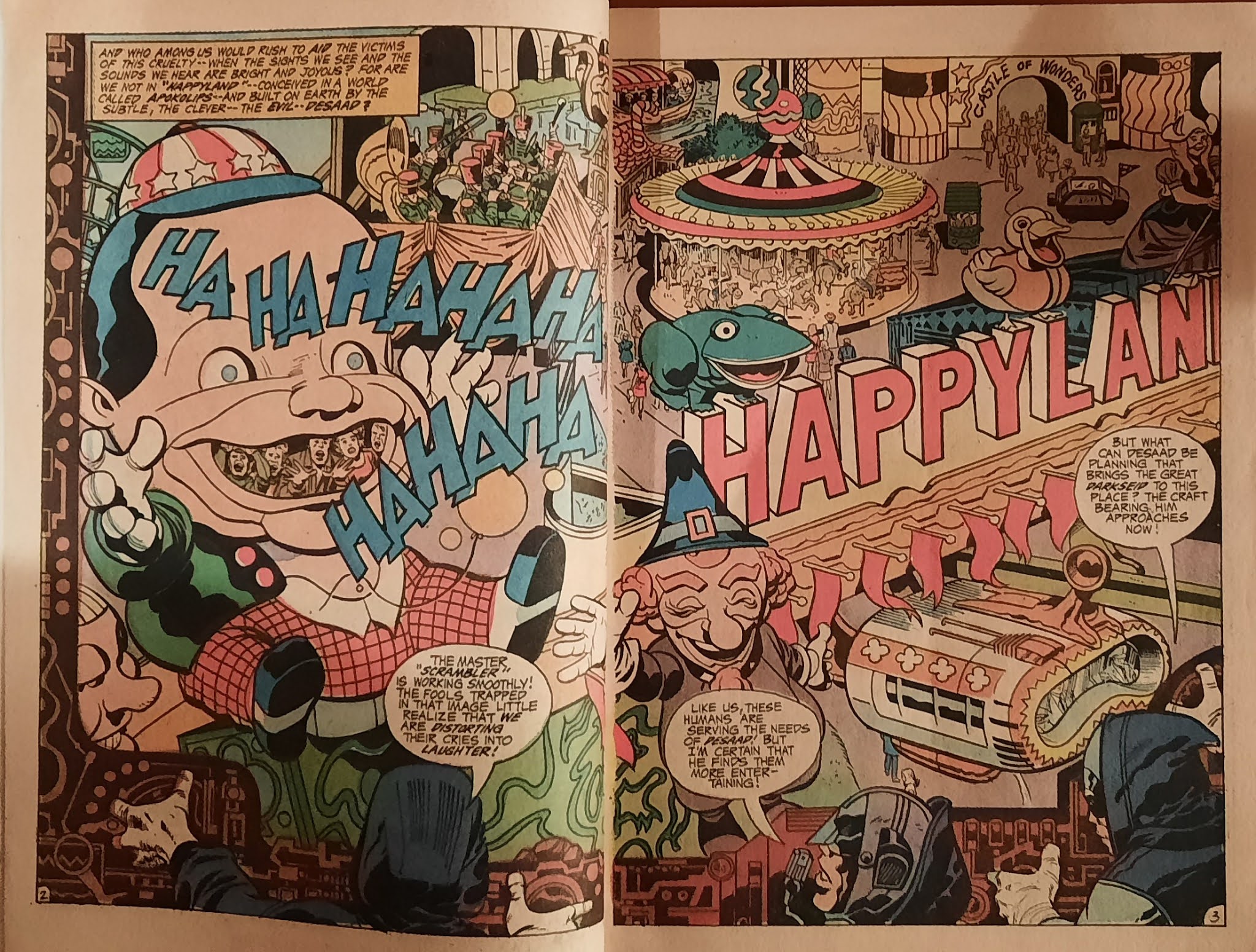
Forever People # 4, published 50 years ago today, 1 June, 1971, opens with the screaming, parched, desperate denizens of Desaad’s colourless blue Kingdom of the Damned, a deathly Disneyland, called ‘Happyland’. Those who are trapped behind its one-way prison glass include the Forever People. It is not for them to walk leisurely through its happy surrounds and absorb its safe, 1950s perfect world. They are stuck, they are its tormented inmates who are ignored and their voice is not heard.


Desaad, agent of the Apokloliptian State, uses a ‘master scrambler’ to turn the damned’s cries into laughter, their desperation into amusement, their pleas for order into threats. The chilling image of the humpty dumpty figure, with an American flag cap who has a passing resemblance to Nixon, with the voices of the desperate silenced, their cries turning to ashes in their mouths, is like an image of the madness of society trying to carry on as if nothing is happening in Vietnam, nothing is happening in the streets, all is calm like a silent Christmas night, like a Don Rickles comedy special after watching 30 US soldiers get killed by a PAVN 122mm rocket hitting their bunker at Charlie 2³ or seeing 12,000 of your friends get arrested in the May Day protests.⁴

The two ways of seeing the world, the State’s and the counterculture’s were at war and Kirby reflects this conflict in his stories. The incredulity on both sides, how can you believe that, how can you think or do that? Mark Moonrider pleads with the straights who look at him through the glass, from his ‘unbreakable, transparent, cage’: “Help! You out there! Help me! What’s wrong with you?...Why do you just sit and stare?’’ The occupants of the amusement ride, under- the-boardwalk- era clothes and countenance, only see a skeleton howling thanks to Desaad’s scrambler, they see media-created caricatures, like their real-world counterparts on the San Francisco bus tours.  


It’s not the world that is different, it is the way you see it. Your feelings, your awareness changes, what once satisfied, what once made sense, now no longer does, ‘a happy place, turned into hell.’ The non-violent Forever People don’t want revolution, they want to communicate, they want people to hear, to understand. Their strength is in their vulnerability as in previous issues where they connect with outcasts, youth, the crippled. You want them to fight back physically but they don’t or won’t.⁵ The Forever People try to change people’s hearts and they suffer for it.

Our heroes are up against an ideology, an all-encompassing anti-life that won’t be reached by the mind, the voice, the heart. In June, 1971, the Forever People and the counter-culture look like they are on the ropes. Yet there is hope. Their lost mother box resists Desaad’s destruction, Serifan alone has the strength to defy Desaad and on the horizon, Sonny Sumo, the Banzai Express chances upon the suddenly materialised mother box and hears it calling out his name for help.

In one of the issue's mini posters after the story’s end, Kirby foreshadows the future, ‘Beautiful Dreamer versus Darkseid! Both hold the key to victory in the strangest war ever fought in comicdom’s history!’

As Beautiful Dreamer lies still beset by Desaad’s nightmares, she like the rest of the Forever People awaits the Mother Box’s call of deliverance. The dream is still alive, through the Looking Glass, someone will see, someone will hear, ‘….carry on, love is coming, love is coming to us all….’.⁶

¹A tour company organised a bus trip around San Francisco’s hippy areas in 1967, the same year as the Summer of Love, billing it ‘the only foreign tour in the domestic United States’, Video of the tour appeared in PBS’ documentary, ‘Summer of Love’

²From Jack Kirby Collector # 24, page seven, April, 1999.

³30 U.S. infantrymen, many from Company A, 1st Battalion, 61st Infantry Regiment, were killed when a PAVN 122mm rocket hit their bunker at Charlie 2 on 21 May, 1971. Source: Veterans of Foreign Wars Magazine, May 2011.

⁴From the New York Times, May 6, 1971, page one.

⁵Kirby deliberately made the Forever People non-violent. ‘The Forever People are non-violent. The Forever People are a challenge to comics, because although they engage in violent activities, they never fight…I don’t feel you have to show blood and gore and guts. I think it’s repellent. I’ve seen enough of it in reality….’ From an interview originally published in Train of Thought # 5, 1971, reprinted in Jack Kirby Collector # 17, November, 1997.

⁶From the lyrics to ‘Carry On’ by Crosby, Stills, Nash and Young. The live version had come out on the double-live album, 4 Way Street, released in April, 1971.

Research this article:                                           

Comics:

-Comics Journal # 134, February 1990 (Jack Kirby interview by Gary Groth)

-Jack Kirby Collector # 17, November 1997 and # 24, April 1999

-Mike’s Amazing World of Comics website

-The Indispensable Kirby & Lee: Stuf’ Said! (Jack Kirby Collector # 75: TwoMorrows).

Popular culture:

-Helter Skelter, the True Story of the Manson Murders (Vincent Bugliosi with Curt Gentry, W.W. Norton, 1994)

-There’s A Riot Going On (Peter Doggett, Canongate, 2007)

-Uncovering the Sixties (Abe Peck, Pantheon, 1985) .

Michael Mead is a 54-year-old New Zealand comic book collector, who likes to think he can do "contextual" commentary reviews of old comics, asking: "where does this story come from?", looking at the social, political, cultural times it came from, the state of the comics industry, the personal and creative journey of the writer or artist, the personal journey of the reader as a child and as an adult. 

As part of this, he is vain enough to think he can bring new insights into Kirby's Fourth World comics and so, on the 50th anniversary of publication of each issue of Superman's Pal Jimmy Olsen, Forever People, New Gods and Mister Miracle, he will publish a contextual commentary. Check out his earlier entries on this blog and tell him to stop talking so pretentiously in the third person for God's sake! 


Let the doors to eternity fly open, there is another way

  ‘Over the carnage rose prophetic a voice, Be not dishearten'd—Affection shall solve the problems                               of F...