Tuesday, June 1, 2021

Through a glass darkly, love is coming to us all

The Forever People are like hippies in Sixties Haight Ashbury looking up at the bus full of straight Middle America staring out at them behind the glass, snapping photos like they are some kind of zoo specimens.¹ State America was happy enough with the counterculture as long as it could be some kind of powerless tourist attraction, a sappy summer camp to send the kids before they grew up and went back to school, shaped up, put on a suit and led the life their fathers and mothers had.

The trouble was that these kids were different and Jack Kirby knew it: “I filled (the Fourth World) with the people of the Sixties, and I called them the Forever People, because they seemed like Forever People to me. They were a new step, a new social event in the epic of America…the Forever People were the young people of their time, beautiful, active, highly intelligent, and wonderful material for stories. I used the young people of the times; the times themselves became the backdrop of my stories.”²

Those same beautiful youths, Mark Moonrider, Big Bear, Serifan, Vykin the Black and Beautiful Dreamer and their real-world counterparts had something to say. It’s just that the culture did not want to hear it and did everything it could to divide society, to disrupt the Movement, to distort the message, to silence the Sixties voice and trap it in an echo chamber ghetto.

Forever People # 4, published 50 years ago today, 1 June, 1971, opens with the screaming, parched, desperate denizens of Desaad’s colourless blue Kingdom of the Damned, a deathly Disneyland, called ‘Happyland’. Those who are trapped behind its one-way prison glass include the Forever People. It is not for them to walk leisurely through its happy surrounds and absorb its safe, 1950s perfect world. They are stuck, they are its tormented inmates who are ignored and their voice is not heard.
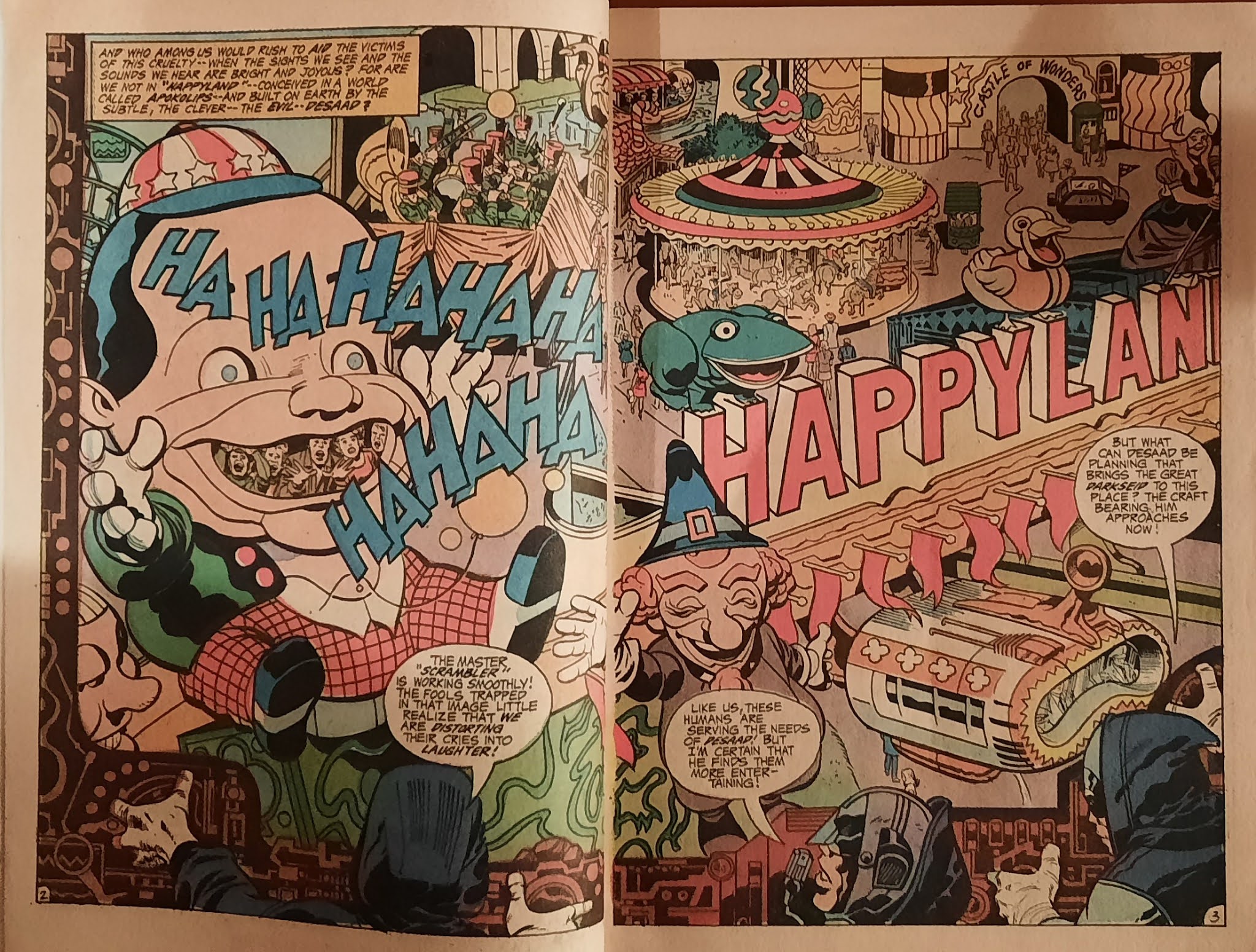


Desaad, agent of the Apokloliptian State, uses a ‘master scrambler’ to turn the damned’s cries into laughter, their desperation into amusement, their pleas for order into threats. The chilling image of the humpty dumpty figure, with an American flag cap who has a passing resemblance to Nixon, with the voices of the desperate silenced, their cries turning to ashes in their mouths, is like an image of the madness of society trying to carry on as if nothing is happening in Vietnam, nothing is happening in the streets, all is calm like a silent Christmas night, like a Don Rickles comedy special after watching 30 US soldiers get killed by a PAVN 122mm rocket hitting their bunker at Charlie 2³ or seeing 12,000 of your friends get arrested in the May Day protests.⁴

The two ways of seeing the world, the State’s and the counterculture’s were at war and Kirby reflects this conflict in his stories. The incredulity on both sides, how can you believe that, how can you think or do that? Mark Moonrider pleads with the straights who look at him through the glass, from his ‘unbreakable, transparent, cage’: “Help! You out there! Help me! What’s wrong with you?...Why do you just sit and stare?’’ The occupants of the amusement ride, under- the-boardwalk- era clothes and countenance, only see a skeleton howling thanks to Desaad’s scrambler, they see media-created caricatures, like their real-world counterparts on the San Francisco bus tours.  


It’s not the world that is different, it is the way you see it. Your feelings, your awareness changes, what once satisfied, what once made sense, now no longer does, ‘a happy place, turned into hell.’ The non-violent Forever People don’t want revolution, they want to communicate, they want people to hear, to understand. Their strength is in their vulnerability as in previous issues where they connect with outcasts, youth, the crippled. You want them to fight back physically but they don’t or won’t.⁵ The Forever People try to change people’s hearts and they suffer for it.

Our heroes are up against an ideology, an all-encompassing anti-life that won’t be reached by the mind, the voice, the heart. In June, 1971, the Forever People and the counter-culture look like they are on the ropes. Yet there is hope. Their lost mother box resists Desaad’s destruction, Serifan alone has the strength to defy Desaad and on the horizon, Sonny Sumo, the Banzai Express chances upon the suddenly materialised mother box and hears it calling out his name for help.

In one of the issue's mini posters after the story’s end, Kirby foreshadows the future, ‘Beautiful Dreamer versus Darkseid! Both hold the key to victory in the strangest war ever fought in comicdom’s history!’

As Beautiful Dreamer lies still beset by Desaad’s nightmares, she like the rest of the Forever People awaits the Mother Box’s call of deliverance. The dream is still alive, through the Looking Glass, someone will see, someone will hear, ‘….carry on, love is coming, love is coming to us all….’.⁶

¹A tour company organised a bus trip around San Francisco’s hippy areas in 1967, the same year as the Summer of Love, billing it ‘the only foreign tour in the domestic United States’, Video of the tour appeared in PBS’ documentary, ‘Summer of Love’

²From Jack Kirby Collector # 24, page seven, April, 1999.

³30 U.S. infantrymen, many from Company A, 1st Battalion, 61st Infantry Regiment, were killed when a PAVN 122mm rocket hit their bunker at Charlie 2 on 21 May, 1971. Source: Veterans of Foreign Wars Magazine, May 2011.

⁴From the New York Times, May 6, 1971, page one.

⁵Kirby deliberately made the Forever People non-violent. ‘The Forever People are non-violent. The Forever People are a challenge to comics, because although they engage in violent activities, they never fight…I don’t feel you have to show blood and gore and guts. I think it’s repellent. I’ve seen enough of it in reality….’ From an interview originally published in Train of Thought # 5, 1971, reprinted in Jack Kirby Collector # 17, November, 1997.

⁶From the lyrics to ‘Carry On’ by Crosby, Stills, Nash and Young. The live version had come out on the double-live album, 4 Way Street, released in April, 1971.

Research this article:                                           

Comics:

-Comics Journal # 134, February 1990 (Jack Kirby interview by Gary Groth)

-Jack Kirby Collector # 17, November 1997 and # 24, April 1999

-Mike’s Amazing World of Comics website

-The Indispensable Kirby & Lee: Stuf’ Said! (Jack Kirby Collector # 75: TwoMorrows).

Popular culture:

-Helter Skelter, the True Story of the Manson Murders (Vincent Bugliosi with Curt Gentry, W.W. Norton, 1994)

-There’s A Riot Going On (Peter Doggett, Canongate, 2007)

-Uncovering the Sixties (Abe Peck, Pantheon, 1985) .

Michael Mead is a 54-year-old New Zealand comic book collector, who likes to think he can do "contextual" commentary reviews of old comics, asking: "where does this story come from?", looking at the social, political, cultural times it came from, the state of the comics industry, the personal and creative journey of the writer or artist, the personal journey of the reader as a child and as an adult. 

As part of this, he is vain enough to think he can bring new insights into Kirby's Fourth World comics and so, on the 50th anniversary of publication of each issue of Superman's Pal Jimmy Olsen, Forever People, New Gods and Mister Miracle, he will publish a contextual commentary. Check out his earlier entries on this blog and tell him to stop talking so pretentiously in the third person for God's sake! 


Tuesday, May 25, 2021

Is that a landmine in your lunchbox?


Jimmy Olsen # 139 (July, 1971), published 50 years ago today, is like that joke your Dad tells over and over because he thinks it’s funny and you think it’s lame. Somehow though, it lodges itself in your brain and then you see there’s something more to it. Something you rushed past in your youthful cringe, something he’s slipped in there, like a time capsule that goes ping at a pre-determined time, when you’re ready to see it and when you open the contents, when you unscrew the top of that 1950s metal jar he stuck in the ground, you suddenly see a childhood moment with adult eyes.

In this case that Dad is Jack Kirby’s version of the ‘Merchant of Venom’, ‘insult’ comedian Don Rickles or to be more accurate his lookalike ‘Goody Rickles’, one of Morgan Edge’s research staff at Galaxy Broadcasting Service. National/DC decided to showcase the real Don Rickles, who was riding high with a successful comedy album, TV show and appearance in a prominent movie¹, in two issues of Jimmy Olsen to help promote the comic. Rickles gave his permission for a brief appearance and then felt exploited by National’s fulsome use of his likeness, later disowning the comics.²

Kirby’s treatment of Goody Rickles in Jimmy Olsen # 139 is almost pure comedy. It’s an unexpected change of pace from the main storyline, Morgan Edge’s involvement with Darkseid and Inter-Gang. So it’s unsurprising that readers then and since have panned the two issues. It’s easy to agree with letter-writer Gerald Triano, that Jimmy Olsen “….is being used as a supplement to Mr Kirby’s trilogy of mags, and nothing more.”

Yet there are some very funny moments including Edge’s murderous exchanges with Goody which are like a straight man/funny man stand-up routine, and some pointed satire. As my one-time comic-reading sister said to me when she was reading these commentaries, Kirby is amazingly subversive with a youthful audience. The kind of material, issues, ideas he is exploring, eyeline straight into the brain, heart and consciousness of a child, unnoticed by the contemporaneous adult world and then instantly stand out when that child reader gets old.

The first bit of text on the cover is: “Are you ready for defoliants in your succotash? Are you ready for landmines in your lunchbox?” Vietnam worsening, no end in sight, the counterculture’s final big push, the May Day 1971 protests at Washington D.C. over and each night, over dinner, or at lunch at school, images flashing before your eyes of young men dying, Agent Orange defoliant billowing across the screen, violence on domestic streets, anger and dissent, bitter generational conflict.

The juxtaposition of Kirby’s words mirror the compartmentalisation in society that was happening at the time. The jarring nature of such an all-encompassing conflict expressed as entertainment  ‘up next, more death in Vietnam, followed by the Don Rickles comedy hour, only on ABC!’ It’s like Kirby is saying, ‘this is what they’re serving up to you, are you going to swallow this?’ Jimmy Olsen # 139 follows on the aerodisc heels of Mister Miracle # 3 whose cover copy told readers about the paranoid pill and said ‘buy it, don’t swallow it!’

Kirby’s subversion continues in the vein of his signature Fourth World satire from Forever People # 3, the Glorious Godfrey issue. There’s a cynicism to the lines he feeds Goody, as the costumed researcher veers from slapstick, cornball, physical comedy to undermining authority, puncturing dreams. Goody hugs, mock punches Edge and then the agent of Apokolips becomes frustrated with the Rickles doppelganger: “(Edge) Walter Cronkite won’t get it! Truman Capote won’t get it! But you! – Goody Rickles! You’re going to get it! (Goody) It’s like John Wayne says! The American dream—it works! You just have to eat apple pie and believe!”

These aren’t sentiments your average eight- year- old reader would be used to reading. In its own way it’s a negative nod to the big red S, the idealistic State symbol of everything good, the super dream of truth, justice and the American way. Kirby features Superman prominently in Jimmy Olsen and undermines what he represents at the same time. Not everybody makes it, barriers are there for some but not for others.

The ‘landmine in your lunchbox’ is not a stink bomb put there by one of your friends, it’s not a literal bomb from a B-52, it’s the realisation that despite all the good intentions from others, all your fervent beliefs, things might not be as they seem, things may not work out for you, after all. The joke is an ugly truth. Are you ready for this?

¹Don Rickles was a nationally-know comedian, a peripheral member of Frank Sinatra's Rat Pack with a long list of screen credits. His 1968 comedy album, 'Hello, Dummy!' charted to a high of # 68 in the Billboard top 200 charts. In the same year ABC gave him a variety show which lasted one season. In 1970, Rickles had a notable role in the film Kelly's Heroes, sharing billing with co-stars Clint Eastwood, Telly Savalas, Donald Sutherland and Carroll O'Connor. 

²From Mark Evanier’s ‘News From Me’ website blog, Sunday May 21, 2017 at 1.48pm.

Research this article:                                           

Comics:

-Comics Journal # 134, February 1990 (Jack Kirby interview by Gary Groth)

-Mike’s Amazing World of Comics website

-The Indispensable Kirby & Lee: Stuf’ Said! (Jack Kirby Collector # 75: TwoMorrows).

Popular culture:

-Helter Skelter, the True Story of the Manson Murders (Vincent Bugliosi with Curt Gentry, W.W. Norton, 1994)

-There’s A Riot Going On (Peter Doggett, Canongate, 2007)

-Uncovering the Sixties (Abe Peck, Pantheon, 1985) .

Michael Mead is a 54-year-old New Zealand comic book collector, who likes to think he can do "contextual" commentary reviews of old comics, asking: "where does this story come from?", looking at the social, political, cultural times it came from, the state of the comics industry, the personal and creative journey of the writer or artist, the personal journey of the reader as a child and as an adult. 

As part of this, he is vain enough to think he can bring new insights into Kirby's Fourth World comics and so, on the 50th anniversary of publication of each issue of Superman's Pal Jimmy Olsen, Forever People, New Gods and Mister Miracle, he will publish a contextual commentary. This is his 16th Fourth World commentary. Check out his earlier entries on this blog and tell him to stop talking so pretentiously in the third person for God's sake!  

Tuesday, May 18, 2021

Paranoia in, peace out, the Miracle pill


‘I need someone to show me

The things in life that I can't find

I can't see the things that make

True happiness, I must be blind


Make a joke and I will sigh

And you will laugh and I will cry

Happiness I cannot feel

And love to me is so unreal


And so, as you hear these words

Telling you now of my state

I tell you to enjoy life

I wish I could but it's too late.’

 (Paranoid, Black Sabbath, 1970)¹


Did you have a moment, when it all started slipping away, when you lost hope, when you couldn’t trust anymore, when you became unmoored so far away from anything you yearned for and nothing was as it seemed? Is that when you took the Paranoid Pill? The occupants of Chandler Towers have no choice as they inhale the pill’s vapours and turn into ‘5,000 raving maniacs’ bent on destroying Scott Free in Mister Miracle # 3 (August, 1971), published 50 years ago today.

The predicament Jack Kirby put his super escape artist in via Apokolips’ Dr Bedlam, reflected the feelings some of his readers would have had. Paranoia was widely felt by countercultural youth at the time and with good reason.

From The Ring Magazine Muhammad Ali Special, 2016 pp. 79

On March 8, 1971, on the same night as Muhammad Ali fought Joe Frazier in New York in the ‘Fight of the Century’ with millions of people listening to radios or watching in theatres, the Citizen’s Commission to Investigate the FBI broke into an FBI office outside Philadelphia and stole 800 documents which showed the Government was spying on black and student groups.²

From Time Magazine, 5 April 1971, pg. 15

The Commission released the papers to the New York Times, Los Angeles Times and Washington Post. In June, 1971, the New York Times would publish the ‘Pentagon Papers’ showing how successive American administrations had lied to the public about Vietnam.

Paranoia isn’t bound by history. It comes at us in all times and places when we are at our lowest, when we feel cut off from our natural community, when we feel ‘other’, separate, strange, when we begin to believe happiness, love, is only for other people. Life hasn’t delivered for us and it can drive despair as equally as rage. For some it leads to faith in demagogues such as Glorious Godfrey and Dr Bedlam who play on the grievance paranoia brings, who say there is someone to blame.

Unlike Godfrey, Dr Bedlam doesn’t persuade and delude by words, he doesn’t invite his followers to fool themselves, he simply drugs them with his paranoid pill and lets its vapours blow the top off of their underlying fears, enmities, delusions. Scott Free’s fight against these ‘maniacs’ is like a journey from the unconscious (top floor) to the conscious (bottom floor) as Bedlam sets him the task of getting out of Chandler Towers alive.

Bedlam is Kirby’s rumination on the effects of evil. The bad doctor is only an elemental force until he can inhabit an ‘animate’, until his evil can be given life. Bedlam can only enter a blank slate, a being who has lost the spark behind the eyes, whose pupils are deadened, whose life and actions have corroded their soul, a human husk. 

The animates are like Alison Bechdel’s father, who lived a double life, in her graphic novel about her life, ‘Fun Home.’ To be around him was like being ‘…in the presence of an absence.’ ³ Evil is not a devil, it is not creative, it is anti-life, the absence of good. Invited in, it hollows out the good and leaves only emptiness, it can only animate a lifeless form.

Scott Free faces this kind of evil with Apokolips. If anyone has the right to feel paranoid, it is Mister Miracle. Targeted by Darkseid and Apokolips from birth, abused in Granny’s terror orphanage, constantly looking over his shoulder for the next evil menace, a ‘full second’ from death in traps he willingly puts himself in, he escapes as Mister Miracle because he has seen his fears, he has accepted where they come from and what he must do about it. Like Kirby’s advice to the reader on the front cover of Mister Miracle # 3, ‘Buy it! But don’t swallow it!’ Yes there is chaos, there is fear, there is mania but we don’t have to consume it.

Scott Free hasn’t pushed fear away, he hasn’t run from paranoia, he has let it in to see it, to know it, to prevail over it. “….You can’t visualize the kind of enemy we face unless you truly experience the effects of its power.” Unlike Dr Bedlam’s poor, innocent, victims, who walk on the poisoned ground Bedlam lays down and become infected, Scott’s childhood terrors have inoculated him, built up his immunity, he stares clear-eyed into the abyss and comes out unscathed, because he has already been there.

Facing a vanishing point death at the end of the issue, he seems in an inescapable physical trap but you know he will win because his mind is free. He has found happiness, he has felt love, it’s never too late for Mister Miracle.


‘It don't come easy,

You know it don't come easy.
It don't come easy,
You know it don't come easy.

Got to pay your dues if you wanna sing the blues,
And you know it don't come easy.
You don't have to shout or leap about,
You can even play them easy.

Open up your heart, let's come together,
Use a little love
And we will make it work out better,

I don't ask for much, I only want your trust,
And you know it don't come easy.
And this love of mine keeps growing all the time,
And you know it don't come easy.

Peace, remember peace is how we make it,
Here within your reach
If you're big enough to take it.’

(Ringo Starr, It Don’t Come Easy, # 8 on the Billboard top 100 in the week of 22 May, 1971)


¹Black Sabbath’s Paranoid album was released in the United Kingdom (UK) in September 1970 and went to # 1. The eponymous single was released at the same time and reached number # 4 in the UK charts. In January 1971, the Paranoid album was released in the United States (US), debuted on the Billboard top 200 at # 25 in the week of February 20, 1971 and rose as high as # 12 in the week of March 20, 1971. The US single debuted at # 94 in the week of November 28, 1970 but only reached a high of # 61 in the week of 26 December, 1970.

²Time Magazine, 5 April, 1971, pg.15.

³From Tom Crippen’s review of Alison Bechdel’s Fun Home, The Comics Journal # 278, October 2006, pg. 154.

Research this article:                                           

Comics:

-Comics Journal # 134, February 1990 (Jack Kirby interview by Gary Groth)

-Comics Journal # 278, October 2006

-Fun Home, Alison Bechdel, First Mariner Books, 2007

-Mike’s Amazing World of Comics website

-The Indispensable Kirby & Lee: Stuf’ Said! (Jack Kirby Collector # 75: TwoMorrows).

Popular culture:

-Helter Skelter, the True Story of the Manson Murders (Vincent Bugliosi with Curt Gentry, W.W. Norton, 1994)

-There’s A Riot Going On (Peter Doggett, Canongate, 2007)

-Time Magazine, 5 April, 1971

-Uncovering the Sixties (Abe Peck, Pantheon, 1985) .

Michael Mead is a 54-year-old New Zealand comic book collector, who likes to think he can do "contextual" commentary reviews of old comics, asking: "where does this story come from?", looking at the social, political, cultural times it came from, the state of the comics industry, the personal and creative journey of the writer or artist, the personal journey of the reader as a child and as an adult. 

As part of this, he is vain enough to think he can bring new insights into Kirby's Fourth World comics and so, on the 50th anniversary of publication of each issue of Superman's Pal Jimmy Olsen, Forever People, New Gods and Mister Miracle, he will publish a contextual commentary. Check out his earlier entries on this blog and tell him to stop talking so pretentiously in the third person for God's sake! 


Thursday, April 22, 2021

Black Power goes skiing

It would be tempting to simply see the Black Racer as Jack Kirby doing the Silver Surfer at DC but Vietnam veteran William Walker/Black Racer is nothing less than Black Power on skis.

In New Gods # 3, published 50 years ago today, April 22, 1971, Kirby tackles two Sixties subjects which he has hinted at before in the Fourth World but never quite dealt with so directly, race and the Vietnam war. In doing so he uses his new character, the Black Racer, a kind of armoured knight, inter-galactic space slalom champion, surfing cosmic snow, as a metaphor for Black experience, reflecting the momentous journey from slavery to Sweetback, from subjugation to sovereignty.

Like Vykin the Black in the Forever People, Kirby calls out the Black Racer’s identity by race. There is no White Light-Ray or Mono-cultural Metron equivalent. Partly this is because there were so few black characters at DC at the time, Kanigher’s Jackie Johnson and the Titans’ Mal Duncan are about all National/DC can muster up and even then, they seem bit part players. Kirby’s black characters are front and centre, they announce themselves as ‘Black’ and in this way reflect the growing pride and self-awareness of the black community at the time. ‘Say it loud, I’m Black and I’m proud!’ⁱ

Kirby’s Black Racer would not be out of place in Melvin van Peeble’s Sweet Sweetback’s Baad Asssss Song, one of the first so-called ‘blaxploitation’ films, premiering on 31 March 1971 at the Grand Circus Theatre in Detroit. Three weeks later at the time of New Gods # 3’s release, Sweetback was well on the way to becoming the highest grossing independent film of 1971.²

Black audiences saw black actors leading on screen, not reduced to racial stereotypes or minor roles. Van Peebles made the case for black expression: " 'For me all the stuff has a direct arrow. I've always used my own voice.' As he sees it, each piece demonstrates his main purpose—to controvert 'false black images' whites use in America 'to confuse, drain and colonize our minds.' " ³ Black audiences cheered when Sweetback escaped white Police.⁴

The Black Racer is not a subservient figure, he is the New God of Black Power. At first he is the God of Death, oblivion, a Killer Surfer, as he chases Light-Ray around the Universe in New Gods # 3’s opening panels, a race between the quick and the dead. The comic’s cover asks ‘Is he after Orion….or you?’

Like the air of apocalyptic, malevolent menace from the State, weighing on the minds of American male youth as they turned 18 and feared the draft to Vietnam, the blond, youthful Light-Ray cannot seem to escape the Black Racer’s death touch. The Black Racer is as ruthless as a local draft board or a Viet Cong bullet: “Your time has come, young one! I am no respecter of tender years! Prepare for my touch!’ Light-Ray is only saved by the intervention of Metron who sends the Racer to Earth via Boom Tube.

The Racer is transformed when he arrives. He sees black-on-black crime and then saves black Vietnam veteran Willie Walker from being shot by one of Intergang’s criminals. Willie feels like an image of historic black experience, flat on his back, crippled, with no voice, seemingly powerless. Like a black Jesus, the former Death Racer reaches out his hand in healing, saying, like an answer to prayer, ‘I hear a voice calling my name’, promising Willie ‘the freedom of a great power’ that will also cost him his life.

Like Lazarus, the Racer raises Willie from his bed and Willie sits up, he speaks, Black Movement, Black Voice. Then he stands, and like a former slave, he removes the yoke of his steel collar and evokes the spirit of the striking 1968 Memphis black sanitation workers, who wore placards saying ‘I Am a Man’. Willie says “I’m whole! I’m strong! I’m no longer half alive! Willie Walker no longer needs this aid!” Black Power.

Willie looks for the Black Racer and sees only an empty cloak, like the white (now black) shroud at Jesus’s empty tomb. In that resurrection moment Willie and the spirit of the Black Racer merge, he is transformed from weakness to power, ‘I am the power to make all tremble! I am the Black Racer!’

At this point, the Black Racer’s story becomes about his own autonomy, his own freedom, his own sovereignty and by extension, a commentary on the journey of black people at the time, a race for the same rights and privileges, the same treatment as the white majority. Similar to the Forever People’s pentavalent Infinity Man, the new Black Racer is a complex character. After dealing with the Intergang criminals he says ‘There are no more barriers for him now. Willie Walker now has the freedom of the farthest dimensions. Willie Walker is now one of many messengers. All who make the one entity, the Black Racer.’ The Racer and Willie split and Willie is back in his bed.

Echoing the Almighty, while the Black Racer takes life, he also gives it. It’s up to him to decide. Freedom now, with its own consequences. In life and in death.

Uh, with your bad self

Say it louder (I got a mouth)

Look a'here, some people say we got a lot of malice
Some say it's a lotta nerve
I say we won't quit moving
Til we get what we deserve
We've been buked and we've been scourned
We've been treated bad, talked about
As just as sure as you're born
But just as sure as it take
Two eyes to make a pair, huh
Brother, we can't quit until we get our share

Say it loud,
I'm black and I'm proud
Say it loud,
I'm black and I'm proud, one more time
Say it loud,
I'm black and I'm proud, huh

I've worked on jobs with my feet and my hands
But all the work I did was for the other man
And now we demands a chance
To do things for ourselves
We tired of beating our heads against the wall
And working for someone else

James Brown, 1968, Say It Loud – I’m Black and I’m Proud


¹From James Brown’s two-part August 1968 single, ‘Say It Loud – I’m Black and I’m Proud’. Both parts appeared on the 1968 album, ‘A Soulful Christmas’.

²As noted in Salon.com's article, Black to the Future, August 21, 2002.

³New York Times, August 20, 1972, 'The Boadasssss Success

⁴Salon 

Research this article:                                           

Comics:

-Comics Journal # 134, February 1990 (Jack Kirby interview by Gary Groth)

-Mike’s Amazing World of Comics website

-The Indispensable Kirby & Lee: Stuf’ Said! (Jack Kirby Collector # 75: TwoMorrows).

Popular culture:

-New York Times, 20 August, 1972

-Salon.com 21 August, 2002

-There’s A Riot Going On (Peter Doggett, Canongate, 2007)

-Uncovering the Sixties (Abe Peck, Pantheon, 1985) .

Michael Mead is a 54-year-old New Zealand comic book collector, who likes to think he can do "contextual" commentary reviews of old comics, asking: "where does this story come from?", looking at the social, political, cultural times it came from, the state of the comics industry, the personal and creative journey of the writer or artist, the personal journey of the reader as a child and as an adult. 

As part of this, he is vain enough to think he can bring new insights into Kirby's Fourth World comics and so, on the 50th anniversary of publication of each issue of Superman's Pal Jimmy Olsen, Forever People, New Gods and Mister Miracle, he will publish a contextual commentary. Check out his earlier entries on this blog and tell him to stop talking so pretentiously in the third person for God's sake! 


Tuesday, April 13, 2021

Open your eyes: something bad really is going to happen


 At the very time DC readers were perceiving the relative sophistication of Jack Kirby’s Fourth World stories, Jimmy Olsen went in the opposite direction. Kirby began his world-building tenure at National with Jimmy Olsen # 133 (August, 1970). It was a literal smack in the face to everything we had known before, Jimmy’s character, his relationship with Superman.

Kirby’s first effort resonated with counter-cultural symbolism, it reflected the revolutionary times and the revolution in Kirby’s own creative life as he freed himself from supercilious Stan’s strictures at Marvel. By Jimmy Olsen # 138 (June 1971), published 50 years ago today, April 13th 1971, the parents have taken over the party and Jimmy as defiant, confrontational youth is replaced by an after-the-fact freckled pout face.

Jimmy Olsen was always aimed younger readers, the other Fourth World titles deal with much bigger subjects and themes, different audiences, different sets of  characters, the New Gods (the adults), Forever People (the youth) and Mister Miracle (the individual). Kirby’s tremendous efforts on the other three titles appear to not have left enough in the tank to challenge the reader in the same way.

Readers Ed Newsom and Karl Merris comment on the earlier Jimmy Olsen issues in the letter column for Jimmy Olsen # 138. 


They see Kirby’s sensitive treatment of hippy Hairies, they understand the Biblical allusions with Genesis/New Genesis as the beginning and the Apocalyptical/Apokolips as the end, from Revelation the final book of the Bible, the end of everything. 

If there is one redeeming feature about Jimmy Olsen # 138 that lifts it above a straightforward and admittedly rewarding fight between Superman and the DNAlien (s), it is Kirby’s continuing interest in the apocalypse, what he calls the ‘holacaust’, the ‘disaster’ and how it informs his work and reflects the times.

As Jacob Kurtzberg, a Jewish man, he fought the Nazis in World War II. It was literally life and death, for him, for his buddies, for his people, for the freedom of the Western allies against fascism and the fight to stop the Shoah/Holacaust against European Jews. To say Kirby must have felt the urgency of the fight would be an understatement. Either win or lose everything. There were no other choices. 

As the clock ticks down on the destruction of the Project’s atomic reactor which would result in a massive explosion, killing everybody and destroying Metropolis, you can’t help but lift your head outside the pages of the comic book and see corresponding levels of apocalyptic desperation in the Cold War world of 1971 and ask, like Marvin Gaye, ‘….what’s going on?’¹

In the weeks leading up to the publication of Jimmy Olsen # 138, the left-wing Weather Underground planted a bomb at the US Capitol which resulted in an explosion, Lieutenant William Calley was found guilty for 22 murders at My Lai, Charles Manson was sentenced to death, a toxic Vietnam war seemed to have no end in sight despite President Nixon’s promise to bring 100,000 troops home by Christmas, the inescapable fear for any male youth turning 18 was ever-present that they could be drafted to fight. 

A March 1971 Supreme Court decision took away the ‘just war’ defence for conscientious objectors.² You couldn’t be just against one war, you had to be against them all to avoid a Vietnam tour. A lot of older brothers of Jimmy Olsen readers would have had the very real fear that They Are Coming For Me.

Time Magazine, 22 March, 1971, pg. 52

The apocalypse can be personal, it can come from things you cannot control or it can be self-inflicted. The loss of freedom, loss of property in fire, flood, earthquake, a divorce, the loss of a loved one, the private and public feelings of isolation and disconnectedness as the COVID-19 pandemic stopped everything we knew, changed our safe assumptions about the world and how it worked. So many warnings and then Something Bad Really Did Happen.

Kirby’s comic book countdown to Doom is avoided by a super saviour’s saving grace. In a world like the one we live in, we’ve really got “…to find a way to bring some lovin’ here today…”³Whether it’s the impending apocalypse of environmental or viral/bacterial destruction or a more personal doom, the Apocalypse is a warning to change our ways. You only have so much time. There is a countdown, ‘evil never rests.’ Kirby’s call is always to open your eyes and see the world and yourself differently, don’t let others control you, don’t let big outside forces decide what you think, determine your future. Be your own Revelation. Never the End.

¹Marvin Gaye’s single, ‘What’s Going On’ was at number # 2 in the Billboard top 100 in the week of Jimmy Olsen # 138’s publication.

²In the third week of March, 1971, the US Supreme Court ruled eight to one that conscientious objection is an all-or-nothing proposition. It does not exempt those, however sincere, who object to some wars but not others.’ Time Magazine, 22 March, 1971, pg. 52.

³Lyrics from Marvin Gaye’s ‘What’s Going On’.

Research this article:                                           

Comics:

-Comics Journal # 134, February 1990 (Jack Kirby interview by Gary Groth)

-Mike’s Amazing World of Comics website

-The Indispensable Kirby & Lee: Stuf’ Said! (Jack Kirby Collector # 75: TwoMorrows).

Popular culture:

-Helter Skelter, the True Story of the Manson Murders (Vincent Bugliosi with Curt Gentry, W.W. Norton, 1994)

-There’s A Riot Going On (Peter Doggett, Canongate, 2007)

-Time Magazine, 22 March, 1971

-Uncovering the Sixties (Abe Peck, Pantheon, 1985) .

Michael Mead is a 54-year-old New Zealand comic book collector, who likes to think he can do "contextual" commentary reviews of old comics, asking: "where does this story come from?", looking at the social, political, cultural times it came from, the state of the comics industry, the personal and creative journey of the writer or artist, the personal journey of the reader as a child and as an adult. 

As part of this, he is vain enough to think he can bring new insights into Kirby's Fourth World comics and so, on the 50th anniversary of publication of each issue of Superman's Pal Jimmy Olsen, Forever People, New Gods and Mister Miracle, he will publish a contextual commentary. Check out his earlier entries on this blog and tell him to stop talking so pretentiously in the third person for God's sake! 


Captain's Call

‘O Captain! my Captain! rise up and hear the bells; Rise up—for you the flag is flung—for you the bugle trills, For you bouquets and rib...