Tuesday, December 21, 2021

The cost of victory


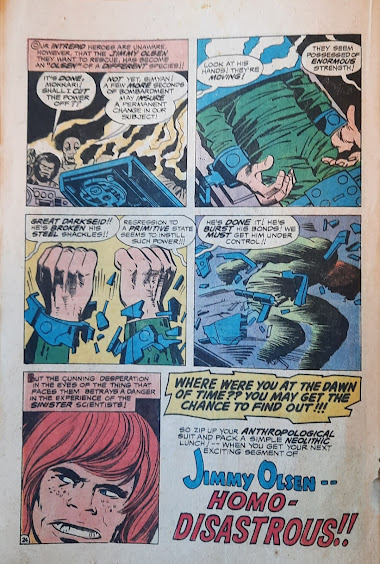
Kamandi Jimmy feverishly tears up the evil factory of the State in Jimmy Olsen # 146 (February, 1972), published 50 years ago today, 21 December, 1971 as Jack Kirby shows us how the culture increasingly saw its rebellious youth as long-haired, violent, inarticulate, angry, animals.

Kirby’s transformation of Jimmy Olsen, both the character and the comic from his first issue, Jimmy Olsen # 133, takes the formerly freckle-faced fop on a wild, unpredictable journey, mirroring the passage of American Sixties youth. Once a conformist, high school, Jerry Lewis-type physical comedian, Jimmy becomes a counter-cultural leader, a warrior. He changes physically into a more muscular, vocal, independent personality, it brings him into conflict with the State represented by Superman.

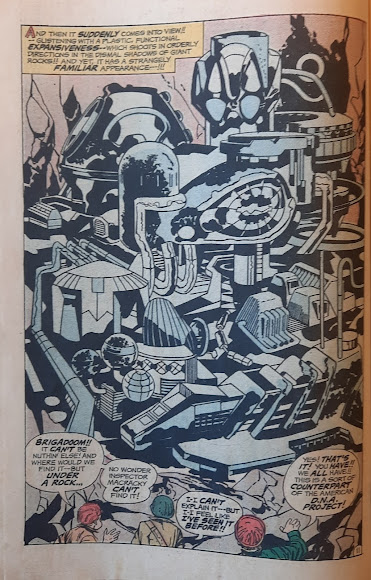
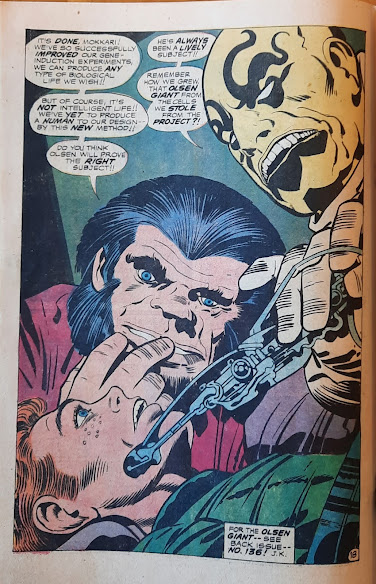
Jimmy and his protégé Newsboy Legion pursue Apokoliptian forces, they hunt for the Evil Factory where Darkseid’s minions Mokkari and Simyan foment their regressive devolved dehumanisation of Jimmy. In the previous issue, Jimmy fought ‘Angry Charlie’ a monstrous stand-in for the threat of the Vietnam draft and fight against the Viet Cong.¹ Now Jimmy is the monster, a raging caveman and in his look, surely a prototype for Kirby’s Kamandi, the first issue of which the King would draw the same month Jimmy Olsen # 146 was published.²

If Jimmy Olsen # 145 was a metaphor for how youth felt about the draft, the threat of being forced to fight and kill Viet Cong and Viet Minh North Vietnamese, then this issue is its counterpoint. Jimmy as Kamandi monster is how the State, how conservative parents, how Nixon’s so-called Silent Majority saw the counter-culture, as ‘homo-disastrous’, a foreground, brutalised, long-haired, angry threat which kept coming to tear down everything that the older generation valued.

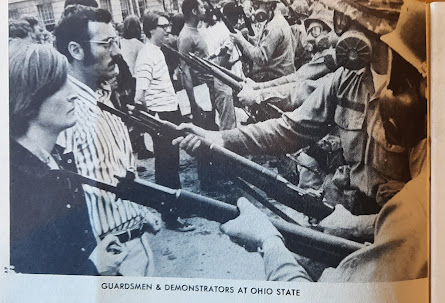
May 1971 had seen the May Day protest against the Vietnam war with 12,000 protesters arrested in Washington D.C., the largest mass arrest in United States’ history.³ June 1971 saw the publication of the Pentagon Papers in the New York Times, showing how successive American administrations had lied to the public about Vietnam, like an evil factory crafting misinformation. In September 1971, 43 people died in the Attica prison rebellion. The State felt under attack and factions of the Movement such as the Weather Underground rejected peaceful solutions to ending the war in Vietnam, perpetrating domestic terrorism instead.
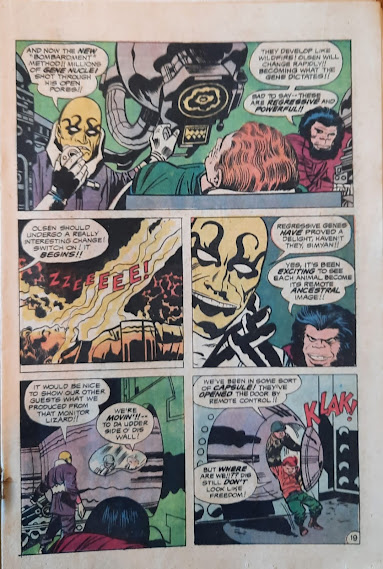
Jimmy as caveman monster is all counter-cultural rage. The remnant of a now divided Movement, destabilised by internal disagreements and by specific State-run programmes whose job it was to put youth in a spin.⁴ Tranquilised by drugs, Kamandi Jimmy initially ‘goes under quite promptly’, perhaps as certain parts of the Youth Revolution had, as he attacks his Evil Factory captors. Mokkari and Simyan aim to ‘take the fight out of him’ but are surprised when they learn Jimmy has escaped their trap, freed by Scrapper and Scrapper Trooper.

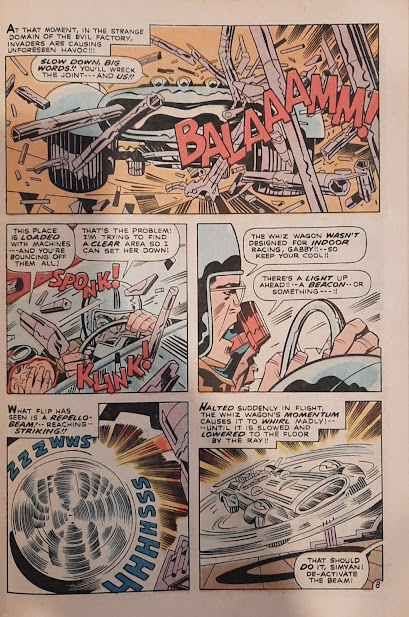
Jimmy attacks his friends, Scrapper, Scrapper Trooper, the Newsboy Legion in the Whiz Wagon, who have escaped doom themselves, literally going off track as they escape the fiery doom of an Evil Factory death trap. Each side of the culture feels the other is leading it to death, youth feared Vietnam, age feared societal disintegration.  Jimmy is single-minded in his violent solution to end the Evil Factory as he leads a parade of prehistoric, screeching, roaring, brawling, wild animals on a rampage to the heart of Evil, like a phalanx of hippies storming the Pentagon.

The peaceful patience of Jimmy’s movement has run out. Brutalised, monsterised, he becomes a symbol, he confirms the worst stereotypes of all those fearful parents and succeeds by destruction, obliterating the Evil Factory as the Newsboy Legion rides on his caveman coattails.

It seems Jimmy and the boys have triumphed. Returned to their own world, seemingly whole and alive, the Evil Factory, ‘…a complex structure, destroyed by its own evil’. The feeling of the final page though is more like relief and loss, than victory. Good has only prevailed through violence, rage. Good is divided. Is this really how we want to win, is this the Sixties dream realised or just the end of a nightmare?

¹See my commentary on Jimmy Olsen # 145, ‘Prisoners of our own heart’ .

²Jack Kirby Collector # 80, pg. 6.

³From the Lawrence Roberts 2020 book, ‘Mayday 1971: A White House at War, a Revolt in the Streets and the Untold History of America’s Biggest Mass Arrest’, pg. xxii.

⁴COINTELPRO and CHAOS were FBI and CIA programmes respectively, designed to discredit the counterculture and maintain the status quo.

Research this article:

Comics:

-According to Jack Kirby (Michael Hill, Lulu, 2021)

-Comics Journal # 134, February 1990 (Jack Kirby interview by Gary Groth)

-Mike’s Amazing World of Comics website

-The indispensable Kirby & Lee: Stuf’ Said! (Jack Kirby Collector # 75: TwoMorrows)

-The equally indispensable Old Gods, New Gods (Jack Kirby Collector # 80: TwoMorrows)

Popular culture:

-Helter Skelter, the True Story of the Manson Murders (Vincent Bugliosi with Curt Gentry, W.W. Norton, 1994)

-There’s A Riot Going On (Peter Doggett, Canongate, 2007)

-Time Magazine, December 20, 1971

-Uncovering the Sixties (Abe Peck, Pantheon, 1985) 

-Vietnam: An Epic History of a Tragic War (Max Hastings, William Collins, 2019)

Michael Mead is a 55-year-old New Zealand comic book collector, who likes to think he can do "contextual" commentary reviews of old comics, asking: "where does this story come from?", looking at the social, political, cultural times it came from, the state of the comics industry, the personal and creative journey of the writer or artist, the personal journey of the reader as a child and as an adult. 

As part of this, he is vain enough to think he can bring new insights into Kirby's Fourth World comics and so, on the 50th anniversary of publication of each issue of Superman's Pal Jimmy Olsen, Forever People, New Gods and Mister Miracle, he will publish a contextual commentary. This is his 33rd of a projected 48 Fourth World commentaries. Check out his earlier entries on this blog and tell him to stop talking so pretentiously in the third person for God's sake! 

The Source of peace

'Father, father

We don't need to escalate
You see, war is not the answer
For only love can conquer hate
You know we've got to find a way
To bring some lovin' here today’

(What’s Going On by Marvin Gaye, 1971)

Jack Kirby’s modern-day epic, ‘The Pact’, in the New Gods # 7 (March, 1972), published 50 years ago today, 21 December, 1971, is so overwhelming in scope, so cosmic in its destiny, so overpowering in its imagery, that’s it’s easy to forget the King’s up-front advice to the reader, ‘…far from being a chronicle of the conflict, this is instead the story of personal struggles…’

The Pact is less about the war between two great empires, New Genesis and Apokolips and more about the transformation of the individual, specifically two sons, Scott Free, beloved of the Highfather Izaya and Orion, scion of Darkseid, one who brings hope to an evil place, the other whose hate is exchanged for love.

Both children have no control over their circumstances, they are pawns of the Pact, an agreement between two fathers, Izaya and Darkseid to stop the war between the two planets. Neither leader will attack the other if his own child could suffer or die. We know the fate of the two boys because all of Kirby’s previous Fourth World stories have been leading up to this mystery moment, where all our questions are resolved as we look back to the origin of conflict and the birth of peace.

Scott Free’s journey is akin to waking up one day in an abusive family after your parents have been killed in a car crash. He has no knowledge of his true origins, given to Granny Goodness as a baby, ‘serene and fragile…in his features.’ Scott is like the baby Jesus in swaddling clothes of Sunday School memory, Granny like a malevolent mother Mary, sardonically naming him ‘Free’ while planning his slavery, revelling in his pain to come.

In a stunning revelation, Granny and Darkseid plan for Scott’s eventual escape from the hell of Apokolips, so the pact that has just been agreed to, can be broken. Scott’s resurrection will be a pretext to war but not before he goes through unbearable suffering. Yet Scott never loses the belief that he will be free.

Orion is older, like a tearaway tween, a gang member in Bel Air, when he arrives, unwillingly, on New Genesis and meets Highfather Izaya. Armed, dangerous, fully knowledgeable about who he is and where he has come from, his lineage, he attacks the high priest of peace. In the hatred on his face burns the fires of a thousand polarised conflicts, hate as the hope that nothing will change, that no mutual understanding will ever come, that people will always be the same and it’s only our tribe that matters.

Izaya offers the open hand of friendship as the knife in Orion’s hands drops to the floor. Where he sought conflict because that is all he knew, Orion is flummoxed by a man who won’t fight. Izaya can speak to Orion and Orion hears, because Izaya has been on the same journey.

Orion’s path to adulthood in Izaya’s care is not simply a series of classes where he is taught peace. Orion is a teacher, he is a reminder about the outsider in the culture and how that culture will only accept someone if they forget themselves, put on the right clothes, wear the right face. Orion exposes the hypocrisy between a society that says it loves all, welcomes all, yet will not act out its pretty words, New Genesis is a place where ugliness shows its true face in beauty.¹

Kirby’s Fourth World is rarely a place of pure good and evil, it is full of flawed, deeply human Gods. Like Izaya the Inheritor, Kirby has been through fire, rain, fighting, death, war, loss and has overcome it. As a scout for the army² in World War II, he saw things, people, questions before others. He knew what was going on, behind the words, in spite of the actions. Through his comics, his pact with the reader is revelation:

‘Come on talk to me
So you can see
What's going on (What's going on)
Yeah, what's going on (What's going on)
Tell me what's going on (What's going on)
I'll tell you, what's going on (What's going on).’

His world is a place of friends. Here is my hand. Hold on, peace will come, peace be with you, only love can conquer hate.

¹See my commentary on New Gods # 5, ‘Ugliness reveals its true face in beauty’

²As detailed in Mark Peters’ Paste article, ‘Eight Ways Comic Book Legend Jack Kirby Fought Fascism’, 16 February, 2017.

Research this article:

Comics:

-According to Jack Kirby (Michael Hill, Lulu, 2021)

-Comics Journal # 134, February 1990 (Jack Kirby interview by Gary Groth)

- Paste, ‘Eight Ways Comic Book Legend Jack Kirby Fought Fascism’, 16 February, 2017, by Mark Peters

-Mike’s Amazing World of Comics website

-The indispensable Kirby & Lee: Stuf’ Said! (Jack Kirby Collector # 75: TwoMorrows)

-The equally indispensable Old Gods, New Gods (Jack Kirby Collector # 80: TwoMorrows)

Popular culture:

-Helter Skelter, the True Story of the Manson Murders (Vincent Bugliosi with Curt Gentry, W.W. Norton, 1994)

-There’s A Riot Going On (Peter Doggett, Canongate, 2007)

-Time Magazine, December 20, 1971

-Uncovering the Sixties (Abe Peck, Pantheon, 1985) 

-Vietnam: An Epic History of a Tragic War (Max Hastings, William Collins, 2019)

Michael Mead is a 55-year-old New Zealand comic book collector, who likes to think he can do "contextual" commentary reviews of old comics, asking: "where does this story come from?", looking at the social, political, cultural times it came from, the state of the comics industry, the personal and creative journey of the writer or artist, the personal journey of the reader as a child and as an adult. 

As part of this, he is vain enough to think he can bring new insights into Kirby's Fourth World comics and so, on the 50th anniversary of publication of each issue of Superman's Pal Jimmy Olsen, Forever People, New Gods and Mister Miracle, he will publish a contextual commentary. This is his 32nd of a projected 48 Fourth World commentaries. Check out his earlier entries on this blog and tell him to stop talking so pretentiously in the third person for God's sake! 

Thursday, December 2, 2021

A world of friends, a revolution of the heart


‘I'll put flowers at your feet and I will sing to you so sweet
And hope my words will carry home to your heart
You left us marching on the road and said how heavy was the load
The years were young, the struggle barely had its start

Do you hear the voices in the night, Bobby?
They're crying for you
See the children in the morning light, Bobby
They're dying’

(‘To Bobby’ by Joan Baez, November, 1971)

By December 1971, what was left of the Movement to End the War in Vietnam was splintered, under attack from within and without. Woodstock Nation was described as a ‘fantasy’ by a former, musical ally.¹ Yet the needs of youth, the desire to be heard, the reality of the draft and fighting and dying in Vietnam were as real as ever.

Alpha power still had to bend and listen to the young, to restore them from the ‘fire pit of destruction’ to the ‘tranquil green of the morning’. In Forever People # 7 (March, 1972), published 50 years ago today, 2 December, 1971, Jack Kirby reaches across time and generations  and hears the forever cries of his people in the night.


When we left Mark Moonrider, Vykin, Big Bear and Beautiful Dreamer last issue they had been wiped out of existence by Darkseid, presumed dead. The remaining member of their New Gods number, Serifan, was alone in his living super-cycle. It’s like an image for the insurgent, now flamed-out Sixties, forgotten, obliterated, lost, alone. Forever People # 7 opens with those lost, lonely voices, New Genesis’ Council of the Young pleads with Highfather, the Moses-like leader of the good planet to save their comrades.


It is the smallest, the youngest of the young that appeals directly to the heart of Highfather’s Alpha power. Esak brings authority and youth together as he makes the case for the restoration of the Forever People, even though they broke the rules: ‘Not against your edicts, Highfather! But for our friends. Is this not a world of friends?’ Esak, in his age-defying wisdom, contrasts the way power is used, the destructive firepit of Darkseid and the ‘power to which lightning dances’ wielded by Highfather who reveals that Mark Moonrider, Vykin, Big Bear and Beautiful Dreamer are not dead by merely misplaced in time.

As Kirby takes us to different time periods where the four forevers have foundered, he sets out his philosophy, his vision of the kind of society he believes in, where youth and age co-exist equally and violence, exploitation, militarism are rejected. The values of the Forever People are at odds with armed revolution, with a resigned acceptance of capitalism or the pursuit of shrill, ideological orthodoxies.

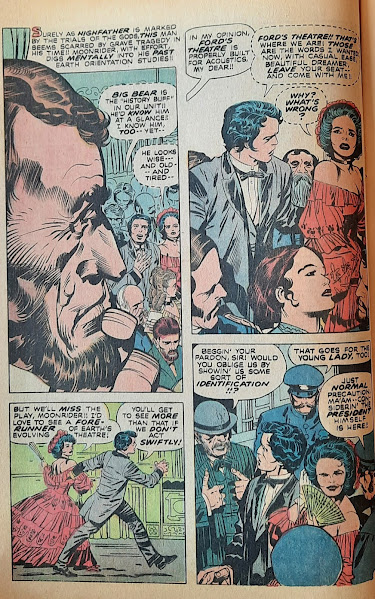
Mark Moonrider and Beautiful Dreamer land at Ford’s Theatre in Washington D.C. on April 14, 1865, where they try to prevent the death of President Abraham Lincoln. In an age of political violence, like the one they left in 1971, Mark and Dreamer rush to stop John Wilkes Booth as he seeks to revive the Confederate cause, ‘Now we must be true to ourselves. We must do what is true to highfather. We must try to stop a killing!’ They fail but their non-violent values are on full display.

Vykin is stranded in 1513 Florida with Ponce de Leon’s troops as they search for gold. Vykin leads them to it but his own interests are in ecology. education, harmony. Ponce’s exploiters later receive due reward for their avarice. 


Big Bear alights in ancient Britain circa fifth century just as the Romans are leaving, in an image that recalls the ongoing withdrawl of US forces from Vietnam.² His interest is in learning from history and he calls for reconciliation between the remaining  British factions, one fighting against the occupiers, the other allied with an imperialist army,  at the end of the War.

The last Forever Person, Serifan battles Glorious Godfrey and his Justifiers, who are ‘absolved of all guilt’ in their murderous intent. Serifan defends himself from attack but is overwhelmed. Highfather saves all five with the ‘alpha bullet’, finding them, restoring them, ‘where I have meant it to be.’

Joan Baez and others such as the Rock Liberation Front³ failed in their attempts to radicalise Bob Dylan, the Who and other artists who refused the weight of singing for the Revolution. Jack Kirby, through his Fourth World characters, set out a path of real dissent from the ‘terrible collision of power’ between opposing cultural forces, away from death and destruction, far from strident ideological voices, his duty was ‘to provide the alternative’, a world of friends, a revolution of the heart.


¹Rolling Stone editor Jann Wenner, said Woodstock Nation was a ‘fantasy’ in a November 11, 1971 article, spurred by a rather ironic dispute over whether or not yippie Abbie Hoffman had stolen parts of his book, Steal This Book. Wenner wrote, ‘As long as there are printing bills to pay, writers who want to earn a living by their craft, people who pay for their groceries, want to raise children and have their homes, Rolling Stone will be a capitalist operation.’ (as quoted in Peck, pg. 276).

²President Nixon announced the withdrawl of 45,000 troops from Vietnam by February 1972, in a White House news conference on 12 November, 1971. See New York Times transcript.

³A.J. Weberman's Rock Liberation Front (RLF) agitated for major musicians to write political music for the youth Revolution. Weberman's major target was Bob Dylan. He failed to radicalise Dylan but later succeeded with John Lennon but not before being forced to recant his vehement criticism of Dylan after the intervention of other members of the RLF, David Peel, Jerry Rubin, Yoko Ono and John Lennon. Doggett, pgs. 461-465.

Research this article:

Comics:

-Comics Journal # 134, February 1990 (Jack Kirby interview by Gary Groth)

-Mike’s Amazing World of Comics website

-The indispensable Kirby & Lee: Stuf’ Said! (Jack Kirby Collector # 75: TwoMorrows)

-The equally indispensable Old Gods, New Gods (Jack Kirby Collector # 80: TwoMorrows)

Popular culture:

-Helter Skelter, the True Story of the Manson Murders (Vincent Bugliosi with Curt Gentry, W.W. Norton, 1994)

-New York Times, 13 November, 1971

-There’s A Riot Going On (Peter Doggett, Canongate, 2007)

-Time Magazine, November 29, 1971

-Uncovering the Sixties (Abe Peck, Pantheon, 1985) 

-Vietnam: An Epic History of a Tragic War (Max Hastings, William Collins, 2019)

Michael Mead is a 55-year-old New Zealand comic book collector, who likes to think he can do "contextual" commentary reviews of old comics, asking: "where does this story come from?", looking at the social, political, cultural times it came from, the state of the comics industry, the personal and creative journey of the writer or artist, the personal journey of the reader as a child and as an adult. 

As part of this, he is vain enough to think he can bring new insights into Kirby's Fourth World comics and so, on the 50th anniversary of publication of each issue of Superman's Pal Jimmy Olsen, Forever People, New Gods and Mister Miracle, he will publish a contextual commentary. This is his 31st of a projected 48 Fourth World commentaries. Check out his earlier entries on this blog and tell him to stop talking so pretentiously in the third person for God's sake! 


Thursday, November 18, 2021

Prisoners of our own heart


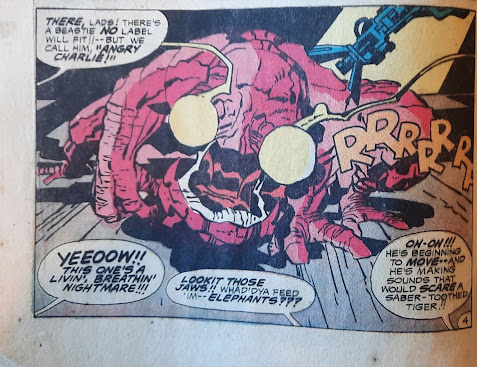
A monster named Charlie, with large, yellow searchlight eyes and a body like a disembodied purple heart, suddenly comes out of a prison door and randomly snatches you off the street. Your friends can do nothing as they watch you vanish, taken away to fight, in your army green, the flesh already gone from your hands as if just the touch of the creature strips off skin to the skeleton.


Time Magazine, May 11, 1970

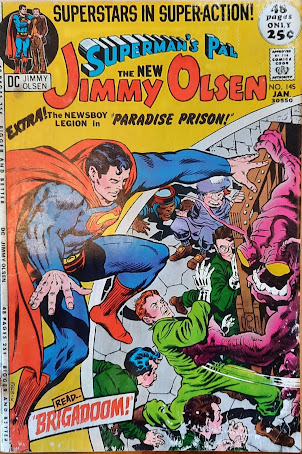
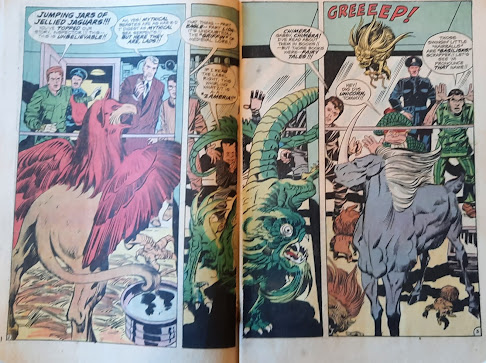
Reading Jimmy Olsen # 145 (January, 1972), published 50 years ago today, 18 November, 1971, it’s hard not to feel the times rip through the pages, the war in Vietnam only one thin layer of meaning deep in what is ostensibly a children’s story about Jimmy Olsen, the Newsboy Legion and the pursuit of a mythical kingdom, the Scottish fairy tale of Brigadoom.

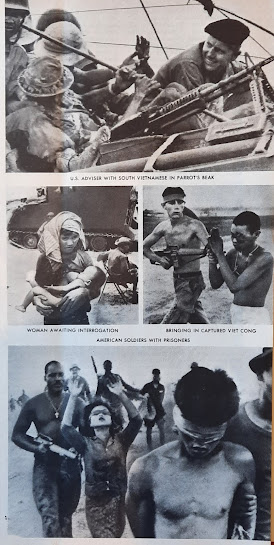
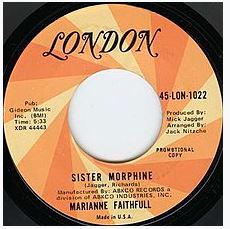
The older brothers of younger readers must have lived moment to moment as they waited in fear for their number to come up in the draft lottery. ‘Angry Charlie’, like the American soldiers’ ‘Charlie’ nickname for the Viet Cong, is certainly a ‘…livin’, breathin’ nightmare’ and like the Stones’ classic ‘Sister Morphine’ released only a few months earlier, those brothers must have wanted someone, something to ‘…turn my nightmares into dreams.’ The reality of the draft era was random selection, injury, death, napalm and by 1971, heavy drug use by soldiers¹ and by youth at home.

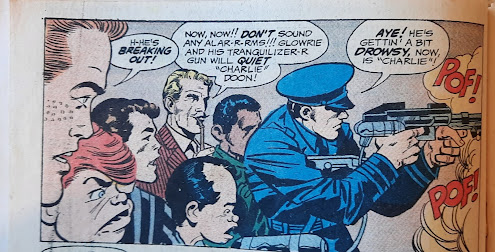
As Jimmy and the Legionnaires gaze at the mythical creatures at Scotland Yard, they marvel at the fairy tales brought to life, in all their grandeur, ugliness and wonder. The most fearsome is Angry Charlie who is the most active, reaching through the prison bars as the boys fear he may break out. The Scottish policeman Glowrie tranquilises Charlie and says ‘Aye! He’s gettin’ a bit drowsy now,, is Charlie.’

If only that were true in Vietnam for the soldiers and on the streets for the counter-culture. Morale amongst US soldiers was low, the process of ‘Vietnamisation’ allowing the South Vietnamise regime to lead the fight had already taken its toll on US troops who knew ‘the ARVN weren’t willing to fight their own war.’² 1972 would see some of the biggest, bloodiest battles of the war.³


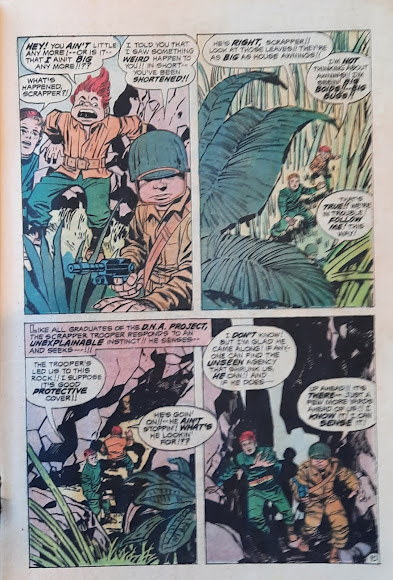
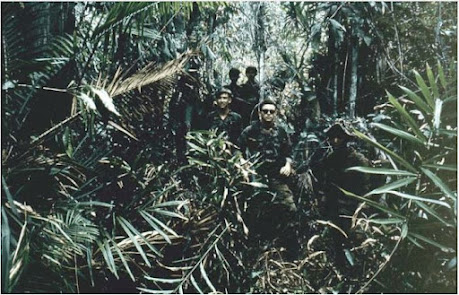
Home and away, people were tired. As Jimmy and Scrapper on land and Flippa Dippa and the other newsboys by sea in the Whizwagon, approach Brigadoom, the gap between the comics fantasy and the world outside begins to reduce, both figuratively and literally. Jimmy and Scrapper, already dressed in military green, begin slogging through foilage as impenetrable as a Vietnamise rừng nhiệt đới.⁴ A strange compressor wave shrinks them in size and leaves are now the size of huge paddies. Already difficult, their quest for the mythical Scottish city becomes even harder, each step facing a bigger obstacle.

What lies in wait for them is a mirage, not Brigadoom but the Evil Factory, the rival Apokoliptian DNA experimentation plant to the Project. Captured by Mokkari and Simyan, Jimmy is laid on the operating table where he is subject to ‘…millions of gene nuclei shot through his open pores…’, nuclei which are ‘…regressive and powerful.’

Kirby has used the idea of reduction and expansion before in Jimmy Olsen, where occupants of a tiny planet rise up to our size, dressed like horror movie characters, symbolic of our fears, all our attempts to minimise what we are afraid of eventually loom up before us where we have to face them⁵. Here the two macabre medical malfeasants cut our heroes down in size so they can control them. Then they go one step further and attempt to turn back evolution.

The ideas of the Sixties were so powerful and so challenging to the State, that every attempt was made by official agencies to undermine and discredit counter-cultural groups⁶, to minimise the impact the kids were having, to return them to safe, comfortable 1950s boys and girls, to turn back the clock and regress to the previous conservative way of life. Woodstock nation stood for the opposite, for the plurality and progression of ideas, a new kind of society.

Jimmy becomes the personification of all this, reduced and regressed, he smashes his shackles, reborn as a freckled Conan, all violence and 1950s bruiser. He wouldn’t be out of place in Philip Zimbardo’s August 1971 experiment at Sanford University⁷ where Zimbardo used students to show the deindividuation and dehumanisation of prison life, as ‘guards’ in anonymous uniforms regressively became increasingly violent in their roles in the experiment.

Kirby seems to be saying that anyone can be brutalised, anyone can be transformed from their best to the worst because we have both qualities inside us. This issue began with a monster, now the spotlight is on the  monster in us, prisoners of our own heart.


US label without Faithfull's songwriting credit

 ‘Well it just goes to show

Things are not what they seem
Please, Sister Morphine, turn my nightmares into dreams
Oh, can't you see I'm fading fast?
And that this shot will be my last

Sweet Cousin Cocaine, lay your cool cool hand on my head
Ah, come on, Sister Morphine, you better make up my bed
'Cause you know and I know in the morning I'll be dead
Yeah, and you can sit around, yeah and you can watch all the
Clean white sheets stained red’ 

Sister Morphine by The RollingStones (written by Marianne Faithfull, Mick Jagger, Keith Richards). Released as a single 21 February, 1969 by Marianne Faithful and a slightly different version by the Stones on the album Sticky Fingers, 23 April, 1971.

¹Hastings, 455-7. In 1971, 60 per cent of US soldiers smoked marijuana, the super-strong Buddha grass. In 1969 only two per cent had tried heroin, by 1971 it was 22 per cent, almost a quarter.

² Ibid, pg. 505.

³ Ibid, pg. 519.

⁴ Vietnamese for 'jungle'.

⁵ See my commentary on Jimmy Olsen # 143

⁶ COINTELPRO and CHAOS were FBI and CIA programmes respectively, designed to discredit the counterculture and maintain the status quo.

For more info see the official website of the experiment. Footage appeared on the recent Apple + TV series, '1971''

Research this article:

Comics:

-Comic Book Creator # 24, Fall 2020

-Comics Journal # 134, February 1990 (Jack Kirby interview by Gary Groth)

-Jack Kirby Collector # 5, May 1995 and # 8, January 1996

-Mike’s Amazing World of Comics website

-The indispensable Kirby & Lee: Stuf’ Said! (Jack Kirby Collector # 75: TwoMorrows)

-The equally indispensable Old Gods, New Gods (Jack Kirby Collector # 80: TwoMorrows)

Popular culture:

-Helter Skelter, the True Story of the Manson Murders (Vincent Bugliosi with Curt Gentry, W.W. Norton, 1994)

-There’s A Riot Going On (Peter Doggett, Canongate, 2007)

-Time Magazine, May 11, 1970

-Uncovering the Sixties (Abe Peck, Pantheon, 1985) 

-Vietnam: An Epic History of a Tragic War (Max Hastings, William Collins, 2019)

Michael Mead is a 55-year-old New Zealand comic book collector, who likes to think he can do "contextual" commentary reviews of old comics, asking: "where does this story come from?", looking at the social, political, cultural times it came from, the state of the comics industry, the personal and creative journey of the writer or artist, the personal journey of the reader as a child and as an adult. 

As part of this, he is vain enough to think he can bring new insights into Kirby's Fourth World comics and so, on the 50th anniversary of publication of each issue of Superman's Pal Jimmy Olsen, Forever People, New Gods and Mister Miracle, he will publish a contextual commentary. This is his 30th of a projected 48 Fourth World commentaries. Check out his earlier entries on this blog and tell him to stop talking so pretentiously in the third person for God's sake! 


Thursday, November 11, 2021

Won't Get Fooled Again?


Jack Kirby’s revolution wasn’t just about creating a new world for himself at National/DC, it was also about exposing the false paradise of Marvel. Liberated from the fold, Kirby, like a comics version of Abbie Hoffman, quit the Movement¹, he dropped out of ringmaster Stan Lee’s faux counter-cultural circus and stopped running. In Mister Miracle # 6 (February, 1972), published 50 years ago today, 11 November, 1971, Kirby takes his fighting to the streets in a barely disguised personal attack on Stan Lee and what Kirby thinks he represents, commerce over creativity, dogma over art.

Kirby’s attack on Lee as Funky Flashman (with a negative nod to Roy Thomas as Houseroy) is visceral right from the splash page get go. Kirby’s narrator characterises Funky (Lee) as ‘…the driven little man who dreams of having it all—the opportunistic spoiler without character or values, who preys on all things like a cannibal!’ Kirby’s stories are not just pencil and ink, they are his creative flesh. He gives part of his own body when he makes comics. Lee cannibalises Kirby’s work by falsely claiming that he, Lee, equally co-created the characters and the content. It’s like Lee is ripping off Kirby’s arms and legs. There is a violence behind Funky’s flash (as his treatment of poor Houseroy shows).

This post war, post Marvel exit attack, the vehemence of it, is not simply because of Kirby’s experience of the ‘transparent second-rater’, the mockingbird copier Lee, it is the final explosion of more than 30 years of hoping for something, hoping something will be better, that promises will be kept, only to find that you were fooled again. Disputes over ownership and recompense for Captain America in the 1940s, cast out of National/DC in the late 50s during the Jack Schiff lawsuit², now disrespected at Marvel in the 60s. ‘This has got to stop! I won’t stand for others being harmed on my account! It’s time I stopped running! It’s time I stood my ground,’ Kirby’s avatar Scott Free speaks his truth.

Part of standing your ground is undermining the ground of others. Lee, for all his shortcomings as a creative, as a writer, was a brilliant marketer. There would be no Marvel without Lee, just as there would be no characters or stories without Kirby, Ditko, Wood et al. The rollicking House of Ideas myth that Lee created was a piece of huckster magic. It engaged readers of all ages, it was fueled by amazing artist-driven and artist-written stories, it became a pop-culture phenomenon and obliterated National/DC from the creative landscape, even if it took until the early 1970s to eclipse them in sales³. To Kirby though, it was a house built on sand.

After a meeting with Mister Miracle, who has engaged him to monetise his miracle show on the road, a ringmaster for a wizard, much as Kirby needed Lee to market his stories, Funky takes Scott Free’s motherbox and inadvertently draws to him the Four Women of the Apokolips who have been after Big Barda, Mad Harriet, Stompa, the lascivious Lashina in bondage gear no less and Dessaad’s sister, Burnadeth, no surprises about what she wants to do.


Funky survives their attentions by throwing Houseroy into the line of fire and Kirby, as if predicting Lee’s departure from writing for Marvel only a few months later in early 1972,  has Funky walking off into a new future behind a chaotic ‘sunset’, his Mockingbird/Marvel estate in ruins: ‘There it goes. –Everything—up in flames! The Mockingbird estate—its happy memories. Mint juleps. Cotillions. Happy slaves singing for the family.’

Behind the bullpen bulletin bumpf, the zappy, clappy patter, lay much unhappiness as Kirby, Ditko, Wood et al largely created the comics but received no proper reward, no proper public acknowledgement, no royalties, no ownership and nowhere near the level of creative freedom they desired, ‘happy’ slaves. Like Pete Townsend’s experience with a commune near his West London home⁴, Kirby doesn’t want to get fooled again and he doesn’t want us to be either.

The Who sang: ‘And the parting on the left, is now parting on the right and the beards have all grown longer overnight.’ Peter Doggett says the song was a ‘scream against those who were telling the Who, and the kids, how to feel and what to do.’ The Who’s role was not to provide false hope but to reflect the negativity felt by ‘the kids about the fight for power which is being waged in their name, but not on their terms.’⁵

Bullpen bulletin from April 1967

We want to believe that Lee and Kirby were always fast friends, that the Bullpen was a wild, raucous pot-pourri of creative extravaganza. That all elements of the Revolution were free but if we had known at the time how the creative people were being exploited, how happy would we have been? Suffocating in a seemingly escape-proof glass bowl yet their struggles were still unseen, behind the ringmaster’s curtain.


Kirby’s satire of Lee is vicious at times and naturally unbalanced, you could well argue that he should have risen above it. Kirby’s purpose though is not simply revenge, it’s getting his due. Like Townsend, he wants his art to triumph over commerce.  He wants us to see the real division of labour, the real balance of creativity. Creativity is earned with spirit and talent, not bought with showmanship. Kirby/Scott Free’s eyes are those of a high priest, Funky’s/Lee's orbs ping with dollar signs.

With the Fourth World, as writer, artist, editor, given his head by Infantino, Kirby is the freest in his career, despite the corporate ownership of his characters. His comics at their best, like Townsend’s songs on Who’s Next, ‘…achieve a liberation of creativity, openness, awareness and spirituality.’ ⁶ Kirby wanted to break down the barriers between artist and audience, he wanted us to see ourselves in his characters, care about things beyond the surface action.

For a time Kirby’s revolution carries all before it, his Fourth World comics in late 1971/early 1972 are the apex of his National/DC achievements, ‘smiling and grinning at the change all around.’ Yet just as Lee is exiting Marvel as a writer and becoming publisher, Carmine Infantino tells Kirby that the Fourth World is being cancelled⁷. The Revolution betrays its believers. ‘Yeah, meet the new boss, same as the old boss.’

Even Scott Free couldn’t escape that trap.

‘We'll be fighting in the streets

With our children at our feet
And the morals that they worship will be gone
And the men who spurred us on
Sit in judgement of all wrong
They decide and the shotgun sings the song

I'll tip my hat to the new constitution
Take a bow for the new revolution
Smile and grin at the change all around
Pick up my guitar and play
Just like yesterday
Then I'll get on my knees and pray
We don't get fooled again

The change, it had to come
We knew it all along
We were liberated from the fold, that's all
And the world looks just the same
And history ain't changed
'Cause the banners, they are flown in the next war

Yeah
Meet the new boss
Same as the old boss’

(Won’t Get Fooled Again, released as a single on 25 June, 1971 from the album, Who’s Next, released on 14 August, 1971)

¹Yippie founder Abbie Hoffman dropped out’ of the Movement to End the War in Vietnam, writing a 1971 essay, ‘I Quit the Movement’, complaining that he had been exploited by those who saw him as a supplier of money and energy. Doggett pg. 448.

²As outlined in Jack Kirby Collector # 80, ‘Old Gods, New Gods’, April, 2021, pg. 26.

³Marvel overtook National/DC in overall sales in 1972. Thanks to Bob Beerbohm for the information:).

⁴Townsend like Dylan was feeling the pressure to be a spokesperson for a counter-cultural movement when his mission, like Dylan was to be an artist first. He had an uneasy experience with a commune near his West London home that coloured his opinions and took this personal experience with him when he wrote ‘Won’t Get Fooled Again.’ Doggett pg. 442-43

⁵Ibid.

⁶Doggett, pg. 441.

⁷ Stan Lee stops writing comics and becomes Marvel's publisher in March 1972, the same month Carmine Infantino tells Kirby the New Gods and The Forever People will be canceled and that Mister Miracle 'must shift away from the New Gods oeuvre.' Stuf' Said pg. 112.

Research this article:

Comics:

-Comics Journal # 134, February 1990 (Jack Kirby interview by Gary Groth)

-Jack Kirby Collector # 5, May 1995 and # 8, January 1996

-Mike’s Amazing World of Comics website

-The indispensable Kirby & Lee: Stuf’ Said! (Jack Kirby Collector # 75: TwoMorrows)

-The equally indispensable Old Gods, New Gods (Jack Kirby Collector # 80: TwoMorrows)

Popular culture:

-Helter Skelter, the True Story of the Manson Murders (Vincent Bugliosi with Curt Gentry, W.W. Norton, 1994)

-There’s A Riot Going On (Peter Doggett, Canongate, 2007)

-Time Magazine, September 27, 1971

-Uncovering the Sixties (Abe Peck, Pantheon, 1985) 

-Vietnam: An Epic History of a Tragic War (Max Hastings, William Collins, 2019)

Michael Mead is a 55-year-old New Zealand comic book collector, who likes to think he can do "contextual" commentary reviews of old comics, asking: "where does this story come from?", looking at the social, political, cultural times it came from, the state of the comics industry, the personal and creative journey of the writer or artist, the personal journey of the reader as a child and as an adult. 

As part of this, he is vain enough to think he can bring new insights into Kirby's Fourth World comics and so, on the 50th anniversary of publication of each issue of Superman's Pal Jimmy Olsen, Forever People, New Gods and Mister Miracle, he will publish a contextual commentary. This is his 29th of a projected 48 Fourth World commentaries. Check out his earlier entries on this blog and tell him to stop talking so pretentiously in the third person for God's sake! 


Let the doors to eternity fly open, there is another way

  ‘Over the carnage rose prophetic a voice, Be not dishearten'd—Affection shall solve the problems                               of F...