Thursday, January 13, 2022

Follow me, I am Free


‘Now only thing I did was wrong

Stayin' in the wilderness too long
Keep your eyes on the prize, hold on

The only thing we did was right
Was the day we started to fight
Keep your eyes on the prize, hold on’

(Eyes on the Prize as sung by Pete Seeger)

We run away from pain. Apokolips escapee Scott Free bathes in it. Why? In Mister Miracle # 7 (April, 1972), published 50 years ago today, 13 January, 1972, Jack Kirby continues to explore Scott’s origin, as Mister Miracle and Big Barda return to Granny Goodness’ terror orphanage on Apokolips to claim Scott’s freedom. To escape from pain is one thing, to stand free from it is quite another.

Scott Free as Mr Miracle willingly challenges death on Earth as an escape artist, using all the tools he learned in the hell of Apokolips. At first it’s how he survived as a child, escaping from his own body and the pain he felt from Granny’s torturers such as Hoogin the harasser, whom he re-meets in this issue.  Now it’s how he lives as an adult, escaping from traps, each escape a reaffirmation of his own journey. He won’t be put down, drowned out, his voice will be heard, he won’t be abused. He seeks to turn the pain he felt as a child into something transformative, serenity in the face of death.

More than that, he realises the role he plays for others, the beaten down orphans who still remain in Granny’s ‘Happiness Home.’ They have succumbed to slogans, threats, despair and finally, most damningly, acceptance. Their minds, spirits, hearts have been colonised by anti-life, they are ground down until they believe the lies Darkseid and Granny tell them.

Evil no longer has to work hard when people say out loud the words that put them in their place, without being forced to. They accept the distorted world as it has been told to them and see slavery, darkness, dictatorship, as truth. As Scott says in Mister Miracle # 1, ‘The trap is not in the chain—it is in the brain…’

Scott brings hope to these desperate denizens of a foul world. As young Scott Free he battles para-demons and wins not through brawn but by outthinking them. Like the Civil Rights anthem, his passage out of despair begins when he refuses to accept how things are and seeks to change them: “…one thing we did right was the day we began to fight, keep your eyes on the prize…”

So against Oberon’s advice Scott goes back to Apokolips, not just to fight but so that downtrodden people can see that their lives can be transformed: ‘Living or dead, you and I are proof to all of Apokolips --- that it can fall!’ Scott is like a suffering servant, someone who will take pain for others so that they can see a different way of being.

Scott is not yet aware that he was allowed to escape from Apokolips or the role that plays in Darkseid breaking the pact between New Genesis and Apokolips (see New Gods # 7). Yet that does not change his desire to be free, freedom from evil not just the freedom to leave it unchallenged. He cannot hide from evil, he must confront it.

In a powerful moment, Scott steps in to save a boy orphan, faces down his own abuser Hoogin and lets him have it: ‘I’ve broken your rules more than once! You remember—don’t you Hoogin!....Tell Granny that I’m back. Tell Granny I claim freedom, by right of combat!’ You’re never free of someone who has had power over you until you show them you’ve risen above them.

Granny, in her disturbing combination of old lady nightie and reptilian battle dress, decides to set Scott’s challenge as ‘section zero’. She hints that this battleground is not a just a physical fight but a psychological breaking of the spirit: ‘….those who enter section zero—never do come out…no, they stay in that house of horrors. They chose to.’

Lumpen anti-life awaits Scott Free. His freedom ride back to Apokolips, a willing decent into hell to liberate himself and others, there is no peace without justice for Scott Free. Keep your eyes on the prize, hold on.

‘The very moment I thought I was lost, the dungeons shook and the chains fell off, keep your eyes on the prize, hold on.’ 

Research this article:

Comics:

-According to Jack Kirby (Michael Hill, Lulu, 2021)

-Comics Journal # 134, February 1990 (Jack Kirby interview by Gary Groth)

-Mike’s Amazing World of Comics website

-The indispensable Kirby & Lee: Stuf’ Said! (Jack Kirby Collector # 75: TwoMorrows)

-The equally indispensable Old Gods, New Gods (Jack Kirby Collector # 80: TwoMorrows)

Popular culture:

-Helter Skelter, the True Story of the Manson Murders (Vincent Bugliosi with Curt Gentry, W.W. Norton, 1994)

-Keep Your Eyes on the Prize (traditional song, Pete Seeger version, Sony Legacy, 2013)

-The Games People Play (Eric Berne, Penguin, 1964)

-There’s A Riot Going On (Peter Doggett, Canongate, 2007)

-The Vietnam War: The Definitive Illustrated History (Penguin Random House, 2017)

-Time Magazine, January 10, 1972

-Uncovering the Sixties (Abe Peck, Pantheon, 1985) 

-Vietnam: An Epic History of a Tragic War (Max Hastings, William Collins, 2019)

Michael Mead is a 55-year-old New Zealand comic book collector, who likes to think he can do "contextual" commentary reviews of old comics, asking: "where does this story come from?", looking at the social, political, cultural times it came from, the state of the comics industry, the personal and creative journey of the writer or artist, the personal journey of the reader as a child and as an adult. 

As part of this, he is vain enough to think he can bring new insights into Kirby's Fourth World comics and so, on the 50th anniversary of publication of each issue of Superman's Pal Jimmy Olsen, Forever People, New Gods and Mister Miracle, he will publish a contextual commentary. This is his 35th of a projected 48 Fourth World commentaries. Check out his earlier entries on this blog and tell him to stop talking so pretentiously in the third person for God's sake! 

Superman needs you in Supertown

If you don’t need me, will you still love me? Superman experiences the loss of every parent as the kids leave home and move past pater and mater, in Jimmy Olsen # 147 (March, 1972), on the stands 50 years ago today, 13 January, 1972. The story. ‘A Superman in Super-Town’ is justly regarded as a classic in the Kirby annals and the King delivers a tale that explores the deep waters of identity, belonging, purpose, hope, ego, loneliness, acceptance.

Kirby laid the seeds for this exploration in earlier issues of the Fourth World¹ as he showed the most powerful being in the Universe as a conflicted, doubting, even anxious personality. Superman, like all of us, wonders, ‘where do I fit it? Who are my people? How can I find a place where I can be myself and be accepted?’

Superman is a creature of loss. He has lost his parents, his friends, an entire world of people like him, the only exception at this point in his history being his cousin Supergirl and his dog Krypto. The Man of Steel is an orphan, a planetary outcast, a hero for millions, alone in that crowd. He receives the constant adulation of the human populace but it brings him no closer to what he most desires. A Man Who Has Everything actually has nothing because he is not with his own, with his tribe, with people who can feed his heart, his mind, his spirit in ways that no others can.

So Kirby takes him to Supertown, New Genesis, home of the New Gods, who all have powers and abilities beyond those of mortal men. Attacked by Magnar and other New Genesis teenagers, the Big Red S is amazed at the power and audacity of Youth as they mistakenly see him as an Apokoliptian villain just as he sees them similarly.

Both sides reconcile and are able to tell each other who they are and Supes lift his eyes heavenward to see the satellite city of New Genesis floating in the sky: “Of course! It can’t be anything else-! It’s Supertown!!! I saw it once – for one fleeting moment.’ In a moment the being who can leap tall buildings in a single bound is transfixed, grounded in longing, his eyes a window into the past and a gaze into the future. Like a comics fan catching a glimpse of a community that they had never seen but always hoped to see, one that would belong to them. Now, Superman sees his home and the look on his face is that of an orphan child not a regal superhero king.

The two New Genesis kids recognise a spirit like their own and they say ‘Well it’s open to friends. This is a world of friends. If you’re a friend to all – you belong among us.’ It’s hard not to become emotional reading those lines because in two sentences Kirby has summarised his life philosophy not just for his characters but for us, the outcast readers and for himself. The sentiment, the desire to believe in a place of Good where you can trust others and be treated well, matters, despite how often humans fall away from it.

Superman’s hopes soar with his flight path to Supertown. He experiences a new kind of peace and he passes by beings as super as him, unnoticed. As he descends to ground level, like a parent dropping in to his children’s apartment, he slips unconsciously into his role as super-helper, only to find in a series of incidents, that his help is not needed. In a place where he should feel the closest to the people, he is unwelcome. Like the Sixties culture around him, the bright, shiny Youth, with strange new powers and practices that he does not understand, don’t want him, don’t need him. It’s as if Bill Haley walked into the Whisky and no one clapped.²

Superman sits with Highfather and begins to lose his identity. He has no role as saviour. There is no one to save.  The man who can run faster than a locomotive does not fit in on a world where everyone can do it. Superman realises he is not special and it hurts his ego, for so long his social role as been help and reward. That parent-child transaction³ is now broken so what does he do? Who is he? In this vulnerable state, he is open to advice.

‘To be frank, I’m a new arrival to New Genesis. And by every rule I should belong here – yet I-I’m finding it difficult to adjust…everyone’s doing fine here without my help.’ Highfather expertly and wisely lets him come to his own solution by asking the right questions, like a good parent would and Superman goes to where he is needed, to save Jimmy and the Newsboys. His identity restored but the conflicts from all sides still pinning him with pressure.

Superman is heroic not because he is perfect, all-powerful. He is heroic because he is none of these things. Infused with all of Jerry Siegel and Joe Schuster’s longing for a better life, Superman lifts above all that drags him down, all the things that don’t work out, all the hopes that are not fulfilled. He carries with him every human heart.

¹See my commentary on Forever People # 1, ‘ Finding Forever in Aging Children’

²The Whisky A Go Go was the counter-culture night club in Los Angeles in the Sixties, it ‘…would transform the Strip into ground zero for American rock ‘n’ roll.’

³Eric Berne was the father of transactional analysis, the theory of parent, adult, child roles and how they play out between people. He explores this model in his book, The Games People Play. Its central concept is the reward we get from different roles, sometimes positive, sometimes negative, sometimes neutral. We do things as part of an exchange, we give to get something in return, in our parent, adult or child states.

Research this article:

Comics:

-According to Jack Kirby (Michael Hill, Lulu, 2021)

-Comics Journal # 134, February 1990 (Jack Kirby interview by Gary Groth)

-Mike’s Amazing World of Comics website

-The indispensable Kirby & Lee: Stuf’ Said! (Jack Kirby Collector # 75: TwoMorrows)

-The equally indispensable Old Gods, New Gods (Jack Kirby Collector # 80: TwoMorrows)

Popular culture:

-Helter Skelter, the True Story of the Manson Murders (Vincent Bugliosi with Curt Gentry, W.W. Norton, 1994)

-LAcurbed.com, ‘Rebellion and Rock ‘n’ Roll: The Sunset Strip in the 60s’, by Hadley Meares, 7 March, 2019

-The Games People Play (Eric Berne, Penguin, 1964)

-There’s A Riot Going On (Peter Doggett, Canongate, 2007)

-The Vietnam War: The Definitive Illustrated History (Penguin Random House, 2017)

-Time Magazine, January 10, 1972

-Uncovering the Sixties (Abe Peck, Pantheon, 1985) 

-Vietnam: An Epic History of a Tragic War (Max Hastings, William Collins, 2019)

Michael Mead is a 55-year-old New Zealand comic book collector, who likes to think he can do "contextual" commentary reviews of old comics, asking: "where does this story come from?", looking at the social, political, cultural times it came from, the state of the comics industry, the personal and creative journey of the writer or artist, the personal journey of the reader as a child and as an adult. 

As part of this, he is vain enough to think he can bring new insights into Kirby's Fourth World comics and so, on the 50th anniversary of publication of each issue of Superman's Pal Jimmy Olsen, Forever People, New Gods and Mister Miracle, he will publish a contextual commentary. This is his 34th of a projected 48 Fourth World commentaries. Check out his earlier entries on this blog and tell him to stop talking so pretentiously in the third person for God's sake! 


Tuesday, December 21, 2021

The cost of victory


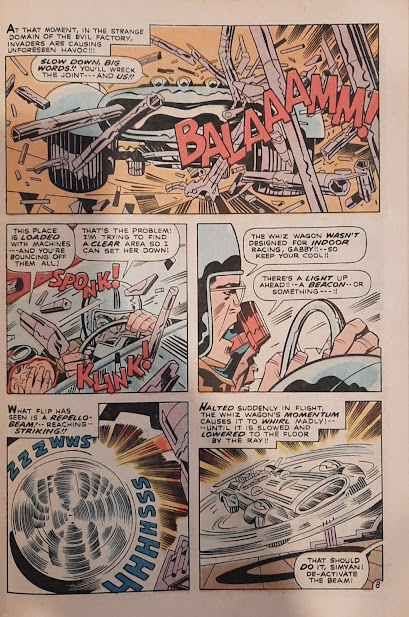
Kamandi Jimmy feverishly tears up the evil factory of the State in Jimmy Olsen # 146 (February, 1972), published 50 years ago today, 21 December, 1971 as Jack Kirby shows us how the culture increasingly saw its rebellious youth as long-haired, violent, inarticulate, angry, animals.

Kirby’s transformation of Jimmy Olsen, both the character and the comic from his first issue, Jimmy Olsen # 133, takes the formerly freckle-faced fop on a wild, unpredictable journey, mirroring the passage of American Sixties youth. Once a conformist, high school, Jerry Lewis-type physical comedian, Jimmy becomes a counter-cultural leader, a warrior. He changes physically into a more muscular, vocal, independent personality, it brings him into conflict with the State represented by Superman.

Jimmy and his protégé Newsboy Legion pursue Apokoliptian forces, they hunt for the Evil Factory where Darkseid’s minions Mokkari and Simyan foment their regressive devolved dehumanisation of Jimmy. In the previous issue, Jimmy fought ‘Angry Charlie’ a monstrous stand-in for the threat of the Vietnam draft and fight against the Viet Cong.¹ Now Jimmy is the monster, a raging caveman and in his look, surely a prototype for Kirby’s Kamandi, the first issue of which the King would draw the same month Jimmy Olsen # 146 was published.²

If Jimmy Olsen # 145 was a metaphor for how youth felt about the draft, the threat of being forced to fight and kill Viet Cong and Viet Minh North Vietnamese, then this issue is its counterpoint. Jimmy as Kamandi monster is how the State, how conservative parents, how Nixon’s so-called Silent Majority saw the counter-culture, as ‘homo-disastrous’, a foreground, brutalised, long-haired, angry threat which kept coming to tear down everything that the older generation valued.

May 1971 had seen the May Day protest against the Vietnam war with 12,000 protesters arrested in Washington D.C., the largest mass arrest in United States’ history.³ June 1971 saw the publication of the Pentagon Papers in the New York Times, showing how successive American administrations had lied to the public about Vietnam, like an evil factory crafting misinformation. In September 1971, 43 people died in the Attica prison rebellion. The State felt under attack and factions of the Movement such as the Weather Underground rejected peaceful solutions to ending the war in Vietnam, perpetrating domestic terrorism instead.

Jimmy as caveman monster is all counter-cultural rage. The remnant of a now divided Movement, destabilised by internal disagreements and by specific State-run programmes whose job it was to put youth in a spin.⁴ Tranquilised by drugs, Kamandi Jimmy initially ‘goes under quite promptly’, perhaps as certain parts of the Youth Revolution had, as he attacks his Evil Factory captors. Mokkari and Simyan aim to ‘take the fight out of him’ but are surprised when they learn Jimmy has escaped their trap, freed by Scrapper and Scrapper Trooper.

Jimmy attacks his friends, Scrapper, Scrapper Trooper, the Newsboy Legion in the Whiz Wagon, who have escaped doom themselves, literally going off track as they escape the fiery doom of an Evil Factory death trap. Each side of the culture feels the other is leading it to death, youth feared Vietnam, age feared societal disintegration.  Jimmy is single-minded in his violent solution to end the Evil Factory as he leads a parade of prehistoric, screeching, roaring, brawling, wild animals on a rampage to the heart of Evil, like a phalanx of hippies storming the Pentagon.

The peaceful patience of Jimmy’s movement has run out. Brutalised, monsterised, he becomes a symbol, he confirms the worst stereotypes of all those fearful parents and succeeds by destruction, obliterating the Evil Factory as the Newsboy Legion rides on his caveman coattails.

It seems Jimmy and the boys have triumphed. Returned to their own world, seemingly whole and alive, the Evil Factory, ‘…a complex structure, destroyed by its own evil’. The feeling of the final page though is more like relief and loss, than victory. Good has only prevailed through violence, rage. Good is divided. Is this really how we want to win, is this the Sixties dream realised or just the end of a nightmare?

¹See my commentary on Jimmy Olsen # 145, ‘Prisoners of our own heart’ .

²Jack Kirby Collector # 80, pg. 6.

³From the Lawrence Roberts 2020 book, ‘Mayday 1971: A White House at War, a Revolt in the Streets and the Untold History of America’s Biggest Mass Arrest’, pg. xxii.

⁴COINTELPRO and CHAOS were FBI and CIA programmes respectively, designed to discredit the counterculture and maintain the status quo.

Research this article:

Comics:

-According to Jack Kirby (Michael Hill, Lulu, 2021)

-Comics Journal # 134, February 1990 (Jack Kirby interview by Gary Groth)

-Mike’s Amazing World of Comics website

-The indispensable Kirby & Lee: Stuf’ Said! (Jack Kirby Collector # 75: TwoMorrows)

-The equally indispensable Old Gods, New Gods (Jack Kirby Collector # 80: TwoMorrows)

Popular culture:

-Helter Skelter, the True Story of the Manson Murders (Vincent Bugliosi with Curt Gentry, W.W. Norton, 1994)

-There’s A Riot Going On (Peter Doggett, Canongate, 2007)

-Time Magazine, December 20, 1971

-Uncovering the Sixties (Abe Peck, Pantheon, 1985) 

-Vietnam: An Epic History of a Tragic War (Max Hastings, William Collins, 2019)

Michael Mead is a 55-year-old New Zealand comic book collector, who likes to think he can do "contextual" commentary reviews of old comics, asking: "where does this story come from?", looking at the social, political, cultural times it came from, the state of the comics industry, the personal and creative journey of the writer or artist, the personal journey of the reader as a child and as an adult. 

As part of this, he is vain enough to think he can bring new insights into Kirby's Fourth World comics and so, on the 50th anniversary of publication of each issue of Superman's Pal Jimmy Olsen, Forever People, New Gods and Mister Miracle, he will publish a contextual commentary. This is his 33rd of a projected 48 Fourth World commentaries. Check out his earlier entries on this blog and tell him to stop talking so pretentiously in the third person for God's sake! 

The Source of peace

'Father, father

We don't need to escalate
You see, war is not the answer
For only love can conquer hate
You know we've got to find a way
To bring some lovin' here today’

(What’s Going On by Marvin Gaye, 1971)

Jack Kirby’s modern-day epic, ‘The Pact’, in the New Gods # 7 (March, 1972), published 50 years ago today, 21 December, 1971, is so overwhelming in scope, so cosmic in its destiny, so overpowering in its imagery, that’s it’s easy to forget the King’s up-front advice to the reader, ‘…far from being a chronicle of the conflict, this is instead the story of personal struggles…’

The Pact is less about the war between two great empires, New Genesis and Apokolips and more about the transformation of the individual, specifically two sons, Scott Free, beloved of the Highfather Izaya and Orion, scion of Darkseid, one who brings hope to an evil place, the other whose hate is exchanged for love.

Both children have no control over their circumstances, they are pawns of the Pact, an agreement between two fathers, Izaya and Darkseid to stop the war between the two planets. Neither leader will attack the other if his own child could suffer or die. We know the fate of the two boys because all of Kirby’s previous Fourth World stories have been leading up to this mystery moment, where all our questions are resolved as we look back to the origin of conflict and the birth of peace.

Scott Free’s journey is akin to waking up one day in an abusive family after your parents have been killed in a car crash. He has no knowledge of his true origins, given to Granny Goodness as a baby, ‘serene and fragile…in his features.’ Scott is like the baby Jesus in swaddling clothes of Sunday School memory, Granny like a malevolent mother Mary, sardonically naming him ‘Free’ while planning his slavery, revelling in his pain to come.

In a stunning revelation, Granny and Darkseid plan for Scott’s eventual escape from the hell of Apokolips, so the pact that has just been agreed to, can be broken. Scott’s resurrection will be a pretext to war but not before he goes through unbearable suffering. Yet Scott never loses the belief that he will be free.

Orion is older, like a tearaway tween, a gang member in Bel Air, when he arrives, unwillingly, on New Genesis and meets Highfather Izaya. Armed, dangerous, fully knowledgeable about who he is and where he has come from, his lineage, he attacks the high priest of peace. In the hatred on his face burns the fires of a thousand polarised conflicts, hate as the hope that nothing will change, that no mutual understanding will ever come, that people will always be the same and it’s only our tribe that matters.

Izaya offers the open hand of friendship as the knife in Orion’s hands drops to the floor. Where he sought conflict because that is all he knew, Orion is flummoxed by a man who won’t fight. Izaya can speak to Orion and Orion hears, because Izaya has been on the same journey.

Orion’s path to adulthood in Izaya’s care is not simply a series of classes where he is taught peace. Orion is a teacher, he is a reminder about the outsider in the culture and how that culture will only accept someone if they forget themselves, put on the right clothes, wear the right face. Orion exposes the hypocrisy between a society that says it loves all, welcomes all, yet will not act out its pretty words, New Genesis is a place where ugliness shows its true face in beauty.¹

Kirby’s Fourth World is rarely a place of pure good and evil, it is full of flawed, deeply human Gods. Like Izaya the Inheritor, Kirby has been through fire, rain, fighting, death, war, loss and has overcome it. As a scout for the army² in World War II, he saw things, people, questions before others. He knew what was going on, behind the words, in spite of the actions. Through his comics, his pact with the reader is revelation:

‘Come on talk to me
So you can see
What's going on (What's going on)
Yeah, what's going on (What's going on)
Tell me what's going on (What's going on)
I'll tell you, what's going on (What's going on).’

His world is a place of friends. Here is my hand. Hold on, peace will come, peace be with you, only love can conquer hate.

¹See my commentary on New Gods # 5, ‘Ugliness reveals its true face in beauty’

²As detailed in Mark Peters’ Paste article, ‘Eight Ways Comic Book Legend Jack Kirby Fought Fascism’, 16 February, 2017.

Research this article:

Comics:

-According to Jack Kirby (Michael Hill, Lulu, 2021)

-Comics Journal # 134, February 1990 (Jack Kirby interview by Gary Groth)

- Paste, ‘Eight Ways Comic Book Legend Jack Kirby Fought Fascism’, 16 February, 2017, by Mark Peters

-Mike’s Amazing World of Comics website

-The indispensable Kirby & Lee: Stuf’ Said! (Jack Kirby Collector # 75: TwoMorrows)

-The equally indispensable Old Gods, New Gods (Jack Kirby Collector # 80: TwoMorrows)

Popular culture:

-Helter Skelter, the True Story of the Manson Murders (Vincent Bugliosi with Curt Gentry, W.W. Norton, 1994)

-There’s A Riot Going On (Peter Doggett, Canongate, 2007)

-Time Magazine, December 20, 1971

-Uncovering the Sixties (Abe Peck, Pantheon, 1985) 

-Vietnam: An Epic History of a Tragic War (Max Hastings, William Collins, 2019)

Michael Mead is a 55-year-old New Zealand comic book collector, who likes to think he can do "contextual" commentary reviews of old comics, asking: "where does this story come from?", looking at the social, political, cultural times it came from, the state of the comics industry, the personal and creative journey of the writer or artist, the personal journey of the reader as a child and as an adult. 

As part of this, he is vain enough to think he can bring new insights into Kirby's Fourth World comics and so, on the 50th anniversary of publication of each issue of Superman's Pal Jimmy Olsen, Forever People, New Gods and Mister Miracle, he will publish a contextual commentary. This is his 32nd of a projected 48 Fourth World commentaries. Check out his earlier entries on this blog and tell him to stop talking so pretentiously in the third person for God's sake! 

Thursday, December 2, 2021

A world of friends, a revolution of the heart


‘I'll put flowers at your feet and I will sing to you so sweet
And hope my words will carry home to your heart
You left us marching on the road and said how heavy was the load
The years were young, the struggle barely had its start

Do you hear the voices in the night, Bobby?
They're crying for you
See the children in the morning light, Bobby
They're dying’

(‘To Bobby’ by Joan Baez, November, 1971)

By December 1971, what was left of the Movement to End the War in Vietnam was splintered, under attack from within and without. Woodstock Nation was described as a ‘fantasy’ by a former, musical ally.¹ Yet the needs of youth, the desire to be heard, the reality of the draft and fighting and dying in Vietnam were as real as ever.

Alpha power still had to bend and listen to the young, to restore them from the ‘fire pit of destruction’ to the ‘tranquil green of the morning’. In Forever People # 7 (March, 1972), published 50 years ago today, 2 December, 1971, Jack Kirby reaches across time and generations  and hears the forever cries of his people in the night.


When we left Mark Moonrider, Vykin, Big Bear and Beautiful Dreamer last issue they had been wiped out of existence by Darkseid, presumed dead. The remaining member of their New Gods number, Serifan, was alone in his living super-cycle. It’s like an image for the insurgent, now flamed-out Sixties, forgotten, obliterated, lost, alone. Forever People # 7 opens with those lost, lonely voices, New Genesis’ Council of the Young pleads with Highfather, the Moses-like leader of the good planet to save their comrades.


It is the smallest, the youngest of the young that appeals directly to the heart of Highfather’s Alpha power. Esak brings authority and youth together as he makes the case for the restoration of the Forever People, even though they broke the rules: ‘Not against your edicts, Highfather! But for our friends. Is this not a world of friends?’ Esak, in his age-defying wisdom, contrasts the way power is used, the destructive firepit of Darkseid and the ‘power to which lightning dances’ wielded by Highfather who reveals that Mark Moonrider, Vykin, Big Bear and Beautiful Dreamer are not dead by merely misplaced in time.

As Kirby takes us to different time periods where the four forevers have foundered, he sets out his philosophy, his vision of the kind of society he believes in, where youth and age co-exist equally and violence, exploitation, militarism are rejected. The values of the Forever People are at odds with armed revolution, with a resigned acceptance of capitalism or the pursuit of shrill, ideological orthodoxies.

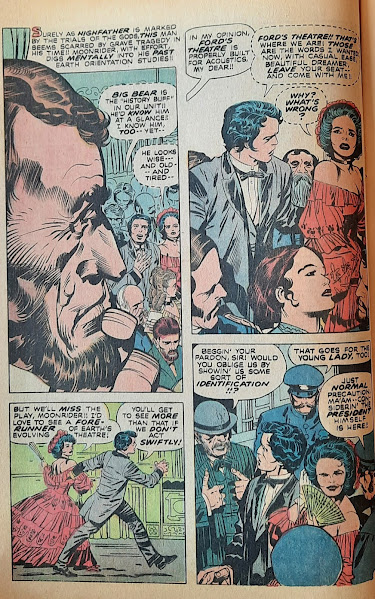
Mark Moonrider and Beautiful Dreamer land at Ford’s Theatre in Washington D.C. on April 14, 1865, where they try to prevent the death of President Abraham Lincoln. In an age of political violence, like the one they left in 1971, Mark and Dreamer rush to stop John Wilkes Booth as he seeks to revive the Confederate cause, ‘Now we must be true to ourselves. We must do what is true to highfather. We must try to stop a killing!’ They fail but their non-violent values are on full display.

Vykin is stranded in 1513 Florida with Ponce de Leon’s troops as they search for gold. Vykin leads them to it but his own interests are in ecology. education, harmony. Ponce’s exploiters later receive due reward for their avarice. 


Big Bear alights in ancient Britain circa fifth century just as the Romans are leaving, in an image that recalls the ongoing withdrawl of US forces from Vietnam.² His interest is in learning from history and he calls for reconciliation between the remaining  British factions, one fighting against the occupiers, the other allied with an imperialist army,  at the end of the War.

The last Forever Person, Serifan battles Glorious Godfrey and his Justifiers, who are ‘absolved of all guilt’ in their murderous intent. Serifan defends himself from attack but is overwhelmed. Highfather saves all five with the ‘alpha bullet’, finding them, restoring them, ‘where I have meant it to be.’

Joan Baez and others such as the Rock Liberation Front³ failed in their attempts to radicalise Bob Dylan, the Who and other artists who refused the weight of singing for the Revolution. Jack Kirby, through his Fourth World characters, set out a path of real dissent from the ‘terrible collision of power’ between opposing cultural forces, away from death and destruction, far from strident ideological voices, his duty was ‘to provide the alternative’, a world of friends, a revolution of the heart.


¹Rolling Stone editor Jann Wenner, said Woodstock Nation was a ‘fantasy’ in a November 11, 1971 article, spurred by a rather ironic dispute over whether or not yippie Abbie Hoffman had stolen parts of his book, Steal This Book. Wenner wrote, ‘As long as there are printing bills to pay, writers who want to earn a living by their craft, people who pay for their groceries, want to raise children and have their homes, Rolling Stone will be a capitalist operation.’ (as quoted in Peck, pg. 276).

²President Nixon announced the withdrawl of 45,000 troops from Vietnam by February 1972, in a White House news conference on 12 November, 1971. See New York Times transcript.

³A.J. Weberman's Rock Liberation Front (RLF) agitated for major musicians to write political music for the youth Revolution. Weberman's major target was Bob Dylan. He failed to radicalise Dylan but later succeeded with John Lennon but not before being forced to recant his vehement criticism of Dylan after the intervention of other members of the RLF, David Peel, Jerry Rubin, Yoko Ono and John Lennon. Doggett, pgs. 461-465.

Research this article:

Comics:

-Comics Journal # 134, February 1990 (Jack Kirby interview by Gary Groth)

-Mike’s Amazing World of Comics website

-The indispensable Kirby & Lee: Stuf’ Said! (Jack Kirby Collector # 75: TwoMorrows)

-The equally indispensable Old Gods, New Gods (Jack Kirby Collector # 80: TwoMorrows)

Popular culture:

-Helter Skelter, the True Story of the Manson Murders (Vincent Bugliosi with Curt Gentry, W.W. Norton, 1994)

-New York Times, 13 November, 1971

-There’s A Riot Going On (Peter Doggett, Canongate, 2007)

-Time Magazine, November 29, 1971

-Uncovering the Sixties (Abe Peck, Pantheon, 1985) 

-Vietnam: An Epic History of a Tragic War (Max Hastings, William Collins, 2019)

Michael Mead is a 55-year-old New Zealand comic book collector, who likes to think he can do "contextual" commentary reviews of old comics, asking: "where does this story come from?", looking at the social, political, cultural times it came from, the state of the comics industry, the personal and creative journey of the writer or artist, the personal journey of the reader as a child and as an adult. 

As part of this, he is vain enough to think he can bring new insights into Kirby's Fourth World comics and so, on the 50th anniversary of publication of each issue of Superman's Pal Jimmy Olsen, Forever People, New Gods and Mister Miracle, he will publish a contextual commentary. This is his 31st of a projected 48 Fourth World commentaries. Check out his earlier entries on this blog and tell him to stop talking so pretentiously in the third person for God's sake! 


Let the doors to eternity fly open, there is another way

  ‘Over the carnage rose prophetic a voice, Be not dishearten'd—Affection shall solve the problems                               of F...